INTRODUCTION
The heart is the engine of life, and when that engine belongs to a child, the importance of its health feels magnified a thousand times. For parents, a diagnosis involving their child’s heart is often one of the most frightening moments they will ever experience. You may have noticed subtle signs—a persistent breathlessness while playing, a blue tint around the lips, or perhaps your baby isn’t feeding as well as they should. These moments are filled with questions, fear, and a deep, protective desire to find the absolute best care available.If you are currently on this journey, please know that you are not alone, and there is hope. Today, pediatric cardiology has reached levels of precision that were unimaginable a few decades ago. Specialized pediatric cardiology hospitals are now equipped to treat even the most complex congenital heart conditions, allowing children to not just survive, but to grow, play, and thrive.The specialized nature of these hospitals is the cornerstone of successful treatment. A child’s heart is not simply a smaller version of an adult heart; it is anatomically different and reacts differently to medications, surgeries, and stresses. This is why specialized centers—those dedicated purely to the delicate needs of infants and children—are vital. They integrate advanced imaging, highly trained pediatric surgeons, and a Neonatal/Pediatric Cardiac ICU into one seamless system of care.At BESTCARDIACHOSPITALS, we are committed to providing parents with the information they need to navigate this path. We believe that clarity is the first step toward comfort. Whether your child requires a minor diagnostic procedure or complex cardiac surgery, understanding the system can help you advocate for the best possible outcome. Every child deserves a healthy start, and with the right expertise, that goal is more attainable than ever before.
WHAT IS A PEDIATRIC CARDIOLOGY HOSPITAL?
A pediatric cardiology hospital is a specialized medical center designed from the ground up to care for the hearts of infants, children, and adolescents. Unlike general hospitals that treat a wide range of patients, these centers focus exclusively on the nervous, electrical, and structural systems of young hearts.The core of these hospitals is the pediatric cardiologist—a doctor who has undergone years of extra training specifically in the diagnosis and management of heart conditions in growing bodies. They work closely with pediatric cardiac surgeons, who are experts in the delicate task of operating on hearts that may be no larger than a strawberry.The main difference between a general hospital and a pediatric heart center is the environment. In a specialized center, everything—from the size of the heart-lung bypass machines to the dosage of medications—is calibrated specifically for children. Furthermore, these hospitals are staffed by nurses and respiratory therapists who are trained to communicate with children and provide the specialized care needed for post-surgical pediatric patients. It is a place where medical brilliance meets child-centered compassion.
COMMON HEART CONDITIONS IN CHILDREN
The human heart begins as a tiny cluster of cells that grow into a complex, four-chambered masterpiece. Sometimes, during development, things don’t go exactly to plan, resulting in a congenital heart defect.
Congenital Heart Defects
These are the most common heart issues in children. They can range from “holes” in the heart to complex structural misalignments.
- ASD (Atrial Septal Defect) and VSD (Ventricular Septal Defect): These are holes in the walls that separate the chambers of the heart.
- Tetralogy of Fallot: A complex condition involving four different structural abnormalities that require expert surgical repair.
- PDA (Patent Ductus Arteriosus): A blood vessel that should have closed after birth but remains open, requiring intervention to ensure proper blood flow.
Other Conditions
- Arrhythmias: These are irregular heart rhythms that can make the heart beat too fast or too slow.
- Cardiomyopathy: A condition where the heart muscle becomes weakened or enlarged, making it harder for the heart to pump blood.
- Blue Baby Syndrome: This occurs when a child’s blood doesn’t have enough oxygen, often causing a bluish tint to the skin and lips, requiring immediate specialized diagnostic care.
COMMON PEDIATRIC HEART CONDITIONS
| Condition | Common Symptoms | Treatment Type | Specialist Needed |
| ASD | Fatigue, breathing issues | Device closure/surgery | Pediatric cardiologist |
| VSD | Poor feeding, sweating | Surgery | Cardiac surgeon |
| PDA | Fast breathing | Catheter procedure | Heart specialist |
| Tetralogy of Fallot | Blue skin/lips | Open-heart surgery | Pediatric cardiac team |
| Arrhythmia | Irregular heartbeat | Medication/procedure | Rhythm specialist |
WHY SPECIALIZED PEDIATRIC CARDIOLOGY HOSPITALS MATTER
Specialization saves lives. When you bring your child to a dedicated pediatric cardiology hospital, you are entering a ecosystem where every team member is an expert in childhood heart care.
The Specialized Cardiac ICU
After heart surgery, a child needs more than just a hospital bed; they need constant, high-tech observation. A Pediatric Cardiac ICU (PCICU) is staffed by intensivists who monitor every beat, every breath, and every lab result with unparalleled focus. They understand the warning signs that indicate a child is struggling to recover, allowing them to intervene long before a minor issue becomes a major complication.
Multidisciplinary Support
These hospitals do not just have surgeons and cardiologists. They often include child life specialists, social workers, and nutritionists who specialize in cardiac patients. They understand that a child’s recovery depends on more than just the success of the surgery—it depends on the child feeling safe, fed, and emotionally supported throughout the process.
ADVANCED DIAGNOSTIC TECHNOLOGY
To treat a condition, you must first visualize it with absolute clarity. Pediatric cardiology hospitals utilize technology that can peer into the heart of a fetus before birth or track the subtle electrical signals of a newborn’s heart.
- Fetal Echocardiography: This allows specialists to diagnose heart defects while the baby is still in the womb, ensuring a care plan is ready from the very first breath.
- Pediatric Echocardiogram: The workhorse of pediatric cardiology, using ultrasound to create moving images of the heart.
- Cardiac Catheterization: A minimally invasive procedure where a thin, flexible tube is guided into the heart, allowing doctors to measure pressures and repair certain defects without a large incision.
PEDIATRIC CARDIAC DIAGNOSTIC TESTS
| Test | Purpose | Conditions Detected |
| Echocardiogram | Heart imaging | Structural defects |
| ECG | Heart rhythm monitoring | Arrhythmias |
| Holter Monitor | Continuous monitoring | Irregular heartbeat |
| Cardiac MRI | Detailed heart imaging | Complex abnormalities |
| Cardiac catheterization | Blood flow evaluation | Congenital defects |
PEDIATRIC HEART SURGERY & PROCEDURES
When surgery is required, parents naturally feel anxious. However, modern techniques have made these procedures remarkably safe.
Open-Heart Surgery
For more complex structural defects, surgeons perform open-heart surgery. Using a heart-lung bypass machine, they temporarily take over the functions of the heart and lungs, allowing the surgeon to perform intricate repairs on the valves or walls of the heart.
Minimally Invasive Procedures
Thanks to advancements in catheters, many conditions (like certain types of holes in the heart) can be repaired without opening the chest. By inserting a small device through a vein, doctors can “plug” a hole or open a narrowed valve, leading to a much shorter hospital stay and faster recovery.
ROLE OF PEDIATRIC CARDIAC ICU & NICU
The ICU is the heartbeat of a heart hospital. For a newborn (NICU) or a child post-surgery, this environment is built to be a safety net.
Constant monitoring ensures that any change in blood pressure or oxygen levels is addressed immediately. Ventilator support is available for children whose bodies need a little help breathing while they focus their energy on healing. Furthermore, these units have strictly enforced infection-control protocols, which is critical for children whose immune systems are temporarily weakened by surgery.
PEDIATRIC CARDIAC ICU SERVICES
| Service | Importance |
| Continuous monitoring | Detect complications early |
| Ventilator support | Breathing assistance |
| Infection control | Protect weak patients |
| Emergency response | Rapid treatment |
| Post-surgery care | Recovery stabilization |
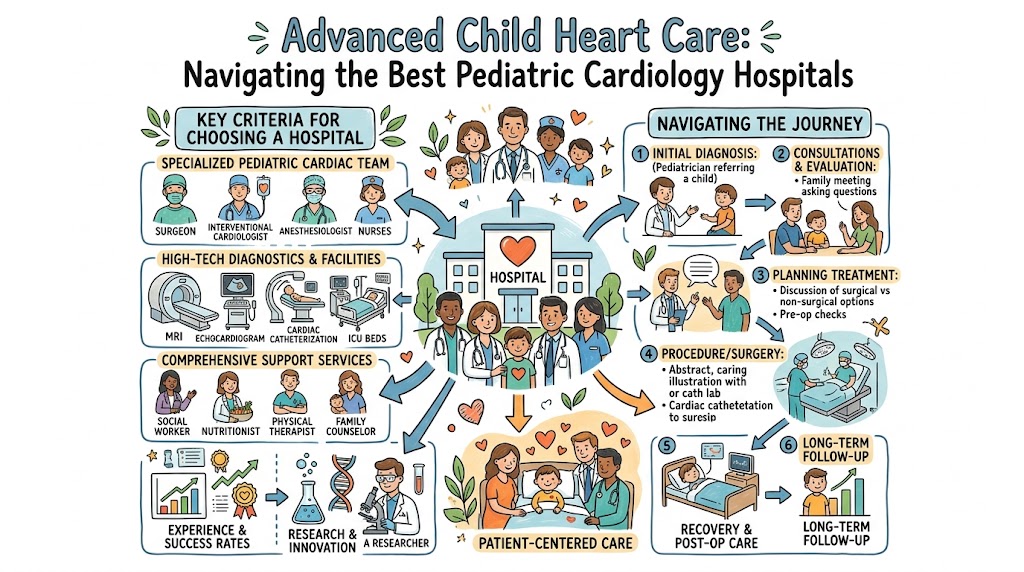
HOW TO CHOOSE THE BEST PEDIATRIC CARDIOLOGY HOSPITAL
How do you make the right choice? Focus on these critical indicators:
- Surgical Volume: Hospitals that perform a high volume of pediatric heart surgeries tend to have better outcomes.
- Specialized Staff: Look for a center that has a dedicated Pediatric Cardiac ICU and specialists who work only with children.
- Emergency Capabilities: Ensure the hospital has 24/7 emergency cardiac care.
- Technology: Do they offer fetal echocardiography and minimally invasive catheter labs?
- Family Support: Look for hospitals that involve parents in the care process and provide counseling.
REAL-LIFE FAMILY SCENARIOS
- The Newborn Journey: A baby is born with a heart defect diagnosed during a routine fetal scan. Because the parents chose a specialized hospital, the cardiac team was waiting in the delivery room, and the baby underwent a successful, life-saving repair just days later.
- The Active Child: A 7-year-old is diagnosed with an arrhythmia. A pediatric electrophysiologist at a top heart hospital performs a minor procedure that eliminates the issue, allowing the child to return to soccer in just a few weeks.
- The Emergency: A child experiences sudden difficulty breathing. An emergency transfer to a specialized pediatric cardiac center ensures immediate diagnostic imaging and expert stabilization.
RECOVERY & LONG-TERM CHILD HEART CARE
Recovery is a family experience. Once the child is home, the focus shifts to nutrition—often these children burn more calories just by breathing, so high-calorie diets might be needed. Activity levels are managed under the guidance of the cardiologist. Most importantly, follow-up visits are the roadmap for the future. These checkups ensure that the repair is holding up as the child grows.
FUTURE OF PEDIATRIC CARDIOLOGY
The future of this field is extraordinary. Researchers are working on “living” heart valves that can grow with the child, potentially eliminating the need for multiple surgeries as the child ages. AI is helping predict heart rhythm issues before they happen, and robotic surgery is allowing for even smaller, more precise incisions.
FEATURES OF TOP PEDIATRIC CARDIOLOGY HOSPITALS
| Feature | Why It Matters |
| Pediatric ICU | Specialized recovery care |
| Experienced surgeons | Better outcomes |
| Advanced imaging | Accurate diagnosis |
| Emergency support | Faster treatment |
| Rehabilitation care | Long-term recovery |
FAQs
1. What does a pediatric cardiology hospital treat?
They treat all heart-related issues in children, from congenital defects to rhythm disorders and acquired heart muscle diseases.
2. What are congenital heart defects?
These are structural heart problems present from birth, affecting how blood flows through the heart.
3. When should a child see a pediatric cardiologist?
If a pediatrician hears a heart murmur, or if a child shows symptoms like blue skin, poor feeding, or extreme fatigue.
4. Is pediatric heart surgery safe?
Yes, in the hands of specialized pediatric cardiac teams, these surgeries have very high success rates.
5. Why are specialized hospitals better?
They have pediatric-specific staff, equipment, and ICUs designed for smaller bodies.
6. Can fetal echo diagnose all defects?
It catches most major defects, allowing for pre-birth planning.
7. How long is the hospital stay?
It varies widely depending on the procedure, but specialists always prioritize getting children home as soon as it is safe.
8. Are catheter procedures painful?
They are performed under anesthesia or sedation, so the child feels no pain.
9. Can children live normal lives after heart surgery?
Yes, most children go on to lead active, full lives, including playing sports.
10. Do I need to be present in the ICU?
Top hospitals encourage parents to be present, as your presence is therapeutic for your child.
11. What is a “blue baby”?
It refers to a child whose blood isn’t getting enough oxygen, often due to a heart defect.
12. How do I prepare my child for surgery?
Hospitals have child-life specialists who can explain the process in an age-appropriate way.
13. Are there long-term side effects?
Most children have no long-term side effects, though regular monitoring is essential as they grow.
14. What is a heart murmur?
Often it is just “extra” sound, but a pediatric cardiologist can perform an echo to ensure it is innocent.
15. Is financial support available?
Many top hospitals have dedicated social workers to help families navigate the financial and insurance side of care.
FINAL CONCLUSION
Choosing a hospital for your child’s heart care is a significant decision, but it is one you do not have to make alone. By choosing a top-tier pediatric cardiology hospital, you are ensuring that your child is surrounded by the best expertise, the most advanced technology, and a team that genuinely cares about your child’s future.Early diagnosis is the most powerful tool we have. Whether you are currently navigating a recent diagnosis or simply learning for the future, remember that pediatric cardiology has evolved to provide miraculous outcomes. Your child’s heart is resilient, and with the support of specialized experts, they can have the healthy, vibrant childhood they deserve.