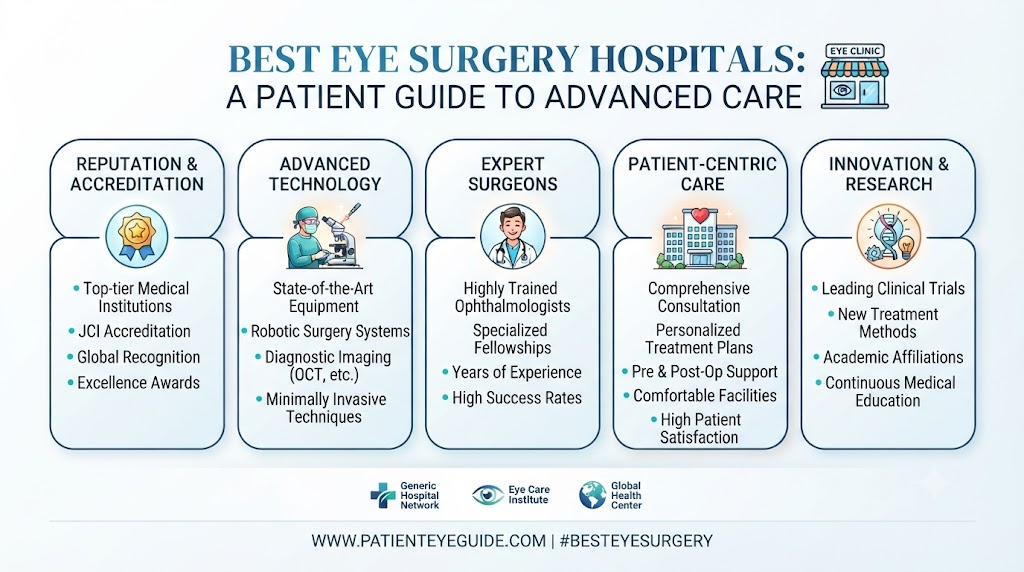
Navigating the landscape of vision correction and major optical treatments can feel incredibly overwhelming for patients and their families. When your eyesight is on the line, selecting a generic clinic simply will not suffice. The quest to find the best eye hospitals involves weighing intricate technological capabilities, surgeon expertise, historical clinical outcomes, and safety infrastructure. Whether you are investigating advanced lens replacements locally or calculating the overall value of medical travel across borders, identifying top-tier institutions is the first and most critical milestone.This comprehensive guide serves as an educational blueprint. We will unpack the exact benchmarks that define the best ophthalmology hospitals globally, delve into specialized clinical structures, outline transparent cost variations, and show you how to navigate institutional data objectively so you can plan your path to clear vision with absolute confidence.
Why Choosing the Right Eye Hospital Matters
Ophthalmology is one of the most technology-dependent fields in modern medicine. A slight variation in diagnostic precision or laser calibration can dramatically alter visual acuity outcomes. Choosing the best eye surgery hospitals ensures that you are backed by sophisticated multi-specialty ecosystems capable of handling both routine vision correction and unforeseen surgical complexities under one roof.
       [ Comprehensive Pre-Op Diagnostics ]
                       │
                       ▼
       [ Customized Advanced Treatment ]
                       │
                       ▼
    [ Integrated Post-Operative Monitoring ]
When an institution invests heavily in healthcare quality and international standards, it directly minimizes patient risk. Premier hospitals maintain specialized wings for diverse vision disorders, ensuring that a patient presenting with an advanced cataract who also suffers from macular degeneration is co-managed by both a lens specialist and a dedicated retina specialist. This standard of integrated medical attention protects long-term vision far better than isolated, single-practitioner setups.
Key Factors to Compare Eye Hospitals
Clinical Accreditations and Safety Standards
Before booking a consultation, evaluate a hospital’s formal certifications. Look for globally recognized marks of quality such as Joint Commission International (JCI) accreditation or national-level equivalents like the National Accreditation Board for Hospitals & Healthcare Providers (NABH) in India. These bodies verify that the center enforces rigorous infection control protocols, maintains sterile operating theaters, and systematically audits surgical success rates to preserve patient safety.
Technology and Infrastructure
The presence of contemporary diagnostic imaging tools and cutting-edge surgical platforms is a signature of the best eye hospitals in the world. Top-tier hubs prioritize therapeutic machinery like femtosecond lasers, microkeratomes, and high-resolution optical coherence tomography (OCT) systems. Superior architecture ensures micro-precision tracking during delicate ocular slicing or reshaping procedures.
Specialist Credentials and Volume
A world-class hospital is defined by its clinical personnel. Research the resident eye surgeon or medical faculty to ensure they possess fellowship training from reputable board boards. Furthermore, surgical volume matters; centers that execute thousands of procedures annually naturally develop streamlined safety workflows, fine-tuned nursing care, and highly refined emergency response protocols.
Types of Eye Surgeries and Technological Variations
Modern ophthalmology offers specialized laser and mechanical treatments tailored to precise structural anomalies of the eye. Understanding these options prevents confusion during clinical consultations.
Cataract Surgery Overview
A cataract represents the progressive clouding of the eye’s natural crystalline lens, typically treated by removing the clouded structure and implanting a clear intraocular lens (IOL).
In traditional phacoemulsification, the eye surgeon uses a handheld blade to make a manual incision before using ultrasound waves to break apart the lens. Conversely, laser-assisted cataract surgery utilizes a computer-guided femtosecond laser to make perfectly circular openings, micro-fragmenting the cataract with exceptional geometric precision and reduced heat energy.
LASIK Surgery Overview
LASIK (Laser-Assisted In Situ Keratomileusis) is a highly sought-after refractive surgery designed to correct nearsightedness, farsightedness, and astigmatism by reshaping the cornea.
During a standard LASIK procedure, a specialized flap is created on the outer layer of the cornea, folded back to allow an excimer laser to sculpt the underlying stromal tissue, and then repositioned to heal naturally without stitches. Advanced variations, such as custom wavefront-guided treatments or completely bladeless “SMILE” lenticule extractions, minimize dry-eye side effects and maintain optimal structural integrity for eligible candidates.
Comparison Tables for Informed Patient Decisions
The following objective comparisons highlight architectural, financial, and clinical distinctions across standard ophthalmic choices.
Table 1: Cataract Surgery vs. LASIK Surgery
| Features | Cataract Surgery | LASIK Surgery |
| Primary Advantage | Restores clarity lost to age-related lens clouding. | Eliminates or significantly reduces reliance on glasses. |
| Key Limitation | Requires physical lens replacement; longer recovery window. | Dependent on strict corneal thickness thresholds. |
| Suitable Patients | Individuals with cloudy vision impacting daily life. | Adults with stable refractive errors and healthy corneas. |
| Cost Considerations | Often covered by insurance plans globally. | Typically classified as an elective cosmetic procedure. |
Table 2: Traditional vs. Laser-Assisted Cataract Surgery
| Features | Traditional Phacoemulsification | Laser-Assisted Cataract Surgery |
| Primary Advantage | Widely available, highly cost-effective, proven track record. | Extreme precision in incisions; lower ultrasound energy. |
| Key Limitation | Relies heavily on manual blade incisions by the surgeon. | Higher out-of-pocket infrastructure fees. |
| Suitable Patients | Broad spectrum of patients with standard cataracts. | Patients selecting premium multifocal or toric lenses. |
| Cost Considerations | Standard base pricing globally. | Premium tier pricing due to specialized laser use. |
Table 3: Government vs. Private Eye Hospitals
| Features | Government Eye Hospitals | Private Eye Hospitals |
| Primary Advantage | Highly subsidized or completely free medical treatments. | Rapid booking, cutting-edge technology, premium comfort. |
| Key Limitation | Significant wait times and dense patient crowding. | High out-of-pocket expenses without insurance cover. |
| Suitable Patients | Local citizens seeking highly affordable base care. | Domestic and international patients prioritizing speed. |
| Cost Considerations | Minimal to non-existent financial barriers. | Full retail pricing with clear tier structures. |
Treatment Cost Considerations and Medical Tourism
Ophthalmic treatment costs fluctuate wildly based on geographical borders, institutional prestige, and technology choices.
Understanding Global Price Variations
In many Western countries, advanced refractive therapies are financially prohibitive for patients without specialized elective insurance coverage. Consequently, tracking global pricing structures has become an essential part of treatment planning for international patients.
Medical Tourism and Eye Care in India
India has grown into a major hub for medical tourism, housing several of the best eye hospitals in India. Patients travel across continents because the country seamlessly pairs world-class clinical talent with highly competitive operational costs.
- Cataract surgery cost in India: Generally ranges from $350 to $1,500 USD per eye, depending heavily on whether a basic monofocal or a premium customized multifocal intraocular lens is selected.
- LASIK surgery cost in India: Typically scales from $500 to $1,800 USD for both eyes, spanning traditional blade systems to modern, personalized topography-guided wavefront lasers.
When evaluating these options, international patient services wings at leading clinics routinely provide consolidated logistical aid, encompassing language interpreters, tele-consultation portals for a second medical opinion, and dedicated visa assistance.
Expert Tips for Selecting Ophthalmic Care
When helping a family member pick an eye care facility, apply these targeted expert screening tips:
- Audit the Diagnostic Suite: Ensure the facility houses a specialized diagnostic imaging lab. Accurate pre-operative tracking prevents errors during premium lens sizing.
- Inquire About ICU Backup: For elderly patients undergoing lengthy procedures, ensure the eye center is attached to or has an active emergency agreement with a general multi-specialty hospital.
- Decline Immediate High-Pressure Upgrades: A reputable eye clinic will present lens options neutrally based on your specific optical charts, lifestyle requirements, and career habits—never via aggressive sales tactics.
Actionable Best Practices for Patients
Planning an eye procedure requires steady coordination. Follow this chronological pathway to streamline your care:
1.Gather Longitudinal Records:Prerequisite Phase.
Collect your historical vision charts, prescription modifications, and detailed systemic health documentation (such as diabetes tracking) to present at your first consult.
2.Acquire Independent Evaluations:Validation Phase.
Utilize digital reference platforms to look up alternative specialist reviews. Always seek a second medical opinion for complex retinal or corneal path variations.
3.Arrange Post-Op Transport:Pre-Surgery Day.
Ocular surgeries require pupillary dilation or protective shielding. Secure a dedicated caregiver or transport option before checking into the surgical suite.
4.Enforce Strict Sterility Protocols:Recovery Window.
Adhere strictly to prescribed antibiotic drop routines. Wear your protective night shields consistently and avoid dust, tap water contact, or rubbing your eyes.
Common Mistakes to Avoid
- Focusing Solely on the Lowest Price: Selecting a clinic based entirely on a cheap voucher or abnormally low quote can expose you to outdated equipment or recycled single-use surgical kits.
- Confusing Optometrists with Ophthalmologists: An optometrist conducts primary eye examinations and measures lens prescriptions. For complex medical issues or surgeries, ensure you consult a board-certified ophthalmologist or specialized eye surgeon.
- Overlooking Post-Operative Access: Ensure your chosen hospital provides accessible emergency care or 24/7 coverage in case you experience an unexpected spike in eye pressure or sudden pain after surgery.
Why Use BestEyeHospitals.com?
Finding the ideal center can feel overwhelming with so many options available online. This is exactly where BestEyeHospitals.com helps you save time and cut through the confusion. The platform acts as a dedicated, independent reference engine designed to simplify your research process.
By consolidating verified institutional details, regional technological capabilities, and specialist backgrounds into clear, accessible formats, the site allows you to compare top providers side-by-side. Whether you are checking care standards locally or comparing costs internationally, the portal provides clear, balanced information to help you find the right care for your needs.
Frequently Asked Questions
1. What differentiates a specialized eye hospital from a standard general hospital?
Specialized eye hospitals consolidate advanced micro-surgical equipment, specialized cleanrooms, and targeted diagnostic tools under one roof. General hospitals cover broader medical needs, but dedicated ophthalmic centers focus their entire staffing, training, and emergency workflows solely on advanced vision care and delicate micro-surgery.
2. Is JCI accreditation important when researching international eye clinics?
Yes, Joint Commission International (JCI) accreditation indicates that a facility adheres to strict global patient safety and medical standards. It ensures that the hospital enforces rigorous sterilization protocols, maintains highly calibrated surgical equipment, and systematically minimizes medical error rates across all treatments.
3. Why do cataract surgery costs vary so much between different hospitals?
Pricing differences are driven by the specific technology used—such as traditional blades versus advanced femtosecond lasers—and the type of lens implant chosen. Basic monofocal lenses are highly affordable, whereas premium multifocal, trifocal, or astigmatism-correcting toric lenses require specialized manufacturing and calibration.
4. Can I undergo LASIK surgery if I have a naturally thin cornea?
Standard LASIK requires a minimum corneal thickness to safely create a protective flap and reshape the tissue underneath. If your diagnostic imaging shows a thin cornea, an experienced ophthalmologist may recommend safer alternative procedures like PRK, LASEK, or implantable collamer lenses (ICL).
5. What are the main signs of infection or complications after eye surgery?
You should seek immediate medical attention if you experience a sudden decrease in vision, worsening eye redness, severe pain that over-the-counter medication doesn’t relieve, or heavy discharge. These symptoms require an urgent evaluation by a specialist to protect your vision.
6. How long do international patients typically need to stay in India for cataract surgery?
Medical tourists should generally plan to stay for 7 to 10 days. This timeline allows for a thorough pre-operative evaluation, the procedure itself (often performed on separate days for each eye), and vital post-operative checkups to confirm the eye is healing safely before travel.
7. Does laser-assisted cataract surgery guarantee perfect 20/20 vision?
No medical procedure can guarantee perfect outcomes. While laser-assisted methods offer exceptional precision and help optimize lens placement, final visual acuity depends heavily on your overall eye health, including the condition of your retina and optic nerve.
8. What is the standard recovery window before returning to work after LASIK?
Most patients notice a significant improvement in their vision within 24 hours and can return to light desk work in 1 to 2 days. However, you must avoid dusty environments, strenuous exercise, and screen fatigue during the initial weeks of healing.
9. Why is a retina specialist separate from a general cataract surgeon?
Ophthalmology includes distinct specialties. A cataract surgeon focuses on treating and replacing the eye’s front crystalline lens, while a retina specialist undergoes advanced fellowship training specifically to manage complex diseases of the back of the eye, such as macular degeneration or retinal detachments.
10. Can standard eye examinations detect underlying systemic health problems?
Yes, a comprehensive eye examination allows specialists to directly view the eye’s blood vessels and nerve pathways. This mapping can reveal early signs of systemic conditions like diabetes, hypertension, high cholesterol, and certain autoimmune disorders before other symptoms appear.
11. Is premium laser eye surgery painful for the patient?
The procedure is generally comfortable. Surgeons apply numbing anesthetic drops to the surface of the eye before the treatment begins. While patients may feel a mild sensation of pressure for a few seconds during laser tracking, actual pain is minimal during the brief process.
12. Do government hospitals use the same advanced lenses as private eye centers?
Many leading government hospitals have access to high-quality intraocular lenses. However, subsidized public facilities typically offer a standardized selection of lenses, whereas private hospitals provide a broader range of premium, highly customized options for specific lifestyle needs.
13. What steps should I take to get a dependable second medical opinion online?
Gather your recent topography maps, OCT diagnostic scans, and written clinical summaries. Upload these clear digital records to a reputable healthcare information platform to have them reviewed by an independent specialist, helping you verify your diagnosis and treatment options.
14. Should I delay my cataract surgery until the lens becomes completely mature?
Modern eye care recommends treating cataracts as soon as they begin to interfere with your daily life, driving safety, or reading comfort. Waiting until a cataract is fully hardened can actually make the removal process more complex and increase the recovery time.
15. What basic items should be included in a patient checklist before eye surgery?
Your preparation checklist should include securing a designated driver for ride support, organizing all prescription eye drops, pausing the use of face creams or cosmetics, and scheduling your first post-operative follow-up appointment with the medical team.
Conclusion
Making informed decisions is the foundation of successful eye care. Your sight is invaluable, and choosing the right care requires looking closely at hospital credentials, surgeon experience, and technological capabilities. By taking the time to carefully evaluate your options, you can avoid common pitfalls, navigate cost differences transparently, and find care tailored to your specific needs. Relying on verified medical insights allows you to approach your treatment journey with clarity and confidence.