Introduction
When a heart emergency strikes, every second is vital. A Cardiac Intensive Care Unit (CICU) is a highly specialized hospital department designed to provide constant, high-level monitoring and advanced life-saving support for patients facing acute cardiovascular distress. Unlike a general medical ward, these units are staffed by experts trained specifically in the complexities of heart function.Hospitals equipped with advanced emergency cardiac ICUs offer the rapid diagnostics and rapid-response infrastructure needed to manage crises like heart attacks or cardiogenic shock effectively. At BestCardiacHospitals, we provide the resources you need to understand these specialized units and how to identify top-tier care providers. This guide explores the critical role these facilities play in modern cardiology and what you should look for in an emergency.
Understanding Emergency Cardiac ICUs
A Cardiac ICU is a dedicated area within a hospital for patients requiring intensive treatment for heart-related illnesses. While a standard Intensive Care Unit (ICU) handles various critical conditions, a Cardiac ICU is focused exclusively on the heart and circulatory system.
Patients in these units benefit from a “Heart Team” approach, where cardiologists, cardiac surgeons, intensivists, and specialized nurses collaborate to manage the patient’s condition. This multidisciplinary strategy ensures that treatment plans are adjusted in real-time based on continuous hemodynamic data.
CARDIAC ICU OVERVIEW TABLE
| Aspect | Description |
| Unit Name | Cardiac Intensive Care Unit (CICU) |
| Primary Purpose | Specialized monitoring for acute heart conditions |
| Patients Treated | Heart attack, heart failure, post-op, arrhythmias |
| Medical Team | Cardiologists, Cardiac Surgeons, Critical Care Nurses |
| Main Goal | Stabilizing cardiac function and preventing complications |
Heart Conditions Managed in Emergency Cardiac ICUs
Acute Heart Attack (Myocardial Infarction)
Requires immediate intervention to restore blood flow, followed by intensive monitoring to prevent further heart muscle damage.
Heart Failure
When the heart struggles to pump efficiently, intensive care is needed to manage fluid balance and blood pressure.
Cardiogenic Shock
A life-threatening state where the heart suddenly cannot pump enough blood to meet the body’s needs.
Serious Cardiac Arrhythmias
Dangerous heart rhythm disturbances that require immediate electrical stabilization or intensive medication management.
Cardiac Arrest Recovery
Post-resuscitation care focused on protecting brain and organ function while stabilizing the heart.
Post-Cardiac Surgery Critical Care
Recovery phase following bypass, valve repair, or other complex cardiovascular procedures.
HEART CONDITIONS TABLE
| Condition | Why ICU Care Is Needed | Typical Monitoring |
| Heart Attack | High risk of instability | Continuous ECG, blood markers |
| Heart Failure | Need for fluid/pressure control | Invasive blood pressure, urine output |
| Cardiogenic Shock | Multi-organ support required | Cardiac output, oxygen saturation |
| Arrhythmias | Risk of sudden rhythm change | Continuous telemetry monitoring |
| Cardiac Arrest | Post-event stability | Neurological and heart monitoring |
| Post-Surgical Care | Surgical site monitoring | Hemodynamics, ventilator support |
Key Features of an Advanced Cardiac ICU
An effective Cardiac ICU must be equipped for immediate action.
- 24/7 Cardiologist Availability: Rapid access to interventional cardiologists.
- Continuous ECG Monitoring: Real-time analysis of the heart’s electrical activity.
- Advanced Ventilator Support: Respiratory assistance when the heart’s strain affects breathing.
- Emergency Catheterization Access: Seamless transfer to the cath lab for procedures like stenting.
- Bedside Echocardiography: Immediate imaging to assess heart wall motion and valve function.
- Dedicated Cardiac Nursing Team: Nurses with specialized certification in cardiovascular life support.
CARDIAC ICU FACILITIES TABLE
| Facility | Purpose | Patient Benefit |
| ECG Monitoring | Heart rhythm surveillance | Early warning of dangerous rhythms |
| Ventilator Support | Respiratory assistance | Ensures oxygen delivery to organs |
| Defibrillators | Correcting fatal arrhythmias | Restores normal heart rhythm |
| Cath Lab Access | Blockage removal/stenting | Re-establishes blood flow |
| Bedside Echo | Instant cardiac imaging | Guides immediate treatment decisions |
| Infusion Pumps | Precision medication delivery | Keeps heart-supporting drugs stable |
Advanced Technologies Used in Cardiac ICUs
Modern ICUs leverage sophisticated technology to manage complex hemodynamic states.
- Hemodynamic Monitoring: Tracks blood pressure within the heart and arteries.
- Portable Echocardiography: Allows for imaging the heart without moving the patient.
- Intra-Aortic Balloon Pump (IABP): Assists the heart in pumping blood throughout the body.
- ECMO: Provides temporary external support for both the heart and lungs in extreme cases.
- Continuous Cardiac Telemetry: Remote, constant tracking of vitals.
- AI-Assisted Monitoring: Software that identifies subtle trends in vitals before an event occurs.
TECHNOLOGY TABLE
| Technology | Purpose | Benefit |
| Cardiac Telemetry | Wireless vital tracking | Allows movement/continuous data |
| Hemodynamic Monitoring | Pressure analysis | Precision management of heart load |
| ECMO | Temporary heart/lung bypass | Saves organs during cardiac failure |
| IABP | Reduced heart workload | Improves blood flow to coronary arteries |
| Portable Echo | Rapid diagnostics | Faster decision-making |
| AI Monitoring | Pattern recognition | Proactive identification of crises |
Hospitals with Emergency Cardiac ICU Facilities
Hospital Overview
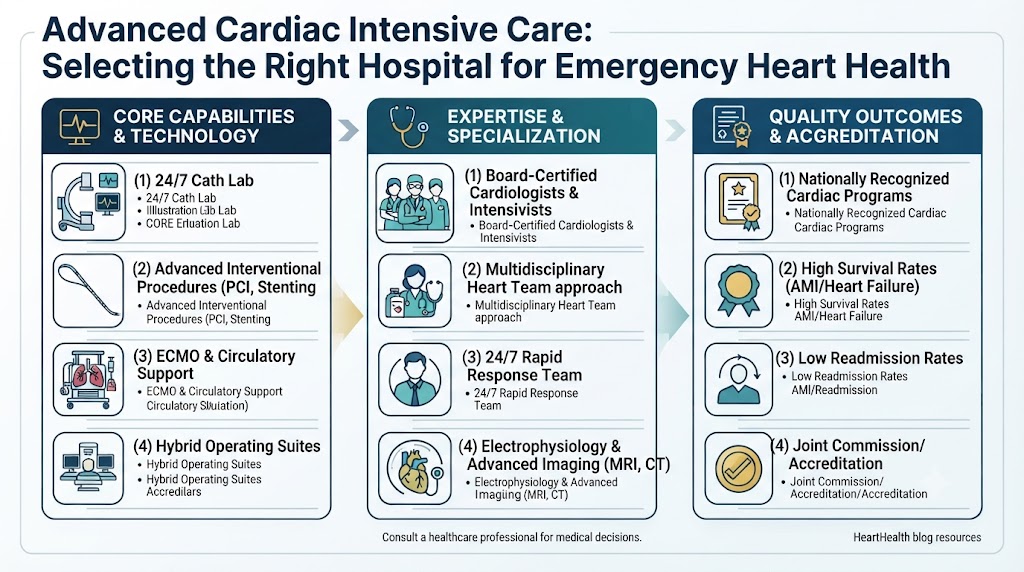
Look for “Heart Centers of Excellence” that maintain high volumes of cardiac procedures, which correlates with better outcomes.
Emergency Cardiology Department
The presence of a 24/7 STEMI (heart attack) team is a non-negotiable standard for top hospitals.
Cardiac ICU Infrastructure
Modern units should be spacious, allowing for complex equipment like ECMO to be positioned around the bed without obstructing staff access.
Critical Care Specialists
The team should feature intensivists with specific fellowship training in cardiovascular critical care.
Emergency Heart Attack Services
Efficient “door-to-balloon” time—the time between arrival and opening a blocked artery—should be a reported and audited metric.
Advanced Cardiac Technologies
Ensure the facility offers on-site structural heart programs, such as TAVR or complex bypass surgery capabilities.
International Patient Services
Many leading hospitals have specialized departments to assist international patients with logistics and medical record transfer.
Why Patients Choose This Hospital
A reputation for compassionate, family-centered care alongside high technical proficiency.
Major Strengths
The primary indicator of a top hospital is its integrated care—where the ICU, Cath Lab, and Surgical suites communicate seamlessly.
What Happens When a Patient Is Admitted to a Cardiac ICU?
- Emergency Assessment: Immediate stabilization of vital signs.
- Cardiac Monitoring: Attaching ECG leads, pulse oximetry, and arterial lines.
- Diagnostic Testing: Blood work and bedside imaging.
- Stabilization: Starting life-supporting medications (vasopressors or antiarrhythmics).
- Ongoing Intensive Care: Monitoring response to initial treatments.
- Recovery Planning: Transitioning to lower-acuity care as heart function improves.
CARDIAC ICU CARE PATHWAY TABLE
| Stage | Main Activity | Goal |
| Admission | Rapid assessment | Immediate stabilization |
| Diagnosis | Imaging and labs | Identification of the crisis |
| Monitoring | Vital tracking | Prevention of sudden decline |
| Treatment | Medication/Procedures | Normalization of heart function |
| Recovery Planning | Goal setting | Safely stepping down to ward |
Benefits of Specialized Emergency Cardiac ICUs
- Faster Emergency Response: Specialized teams move significantly faster than general medical teams.
- Better Continuous Monitoring: Expert eyes are on the data at all times.
- Experienced Cardiology Teams: Focus means mastery of rare and complex complications.
- Advanced Life Support: Access to cutting-edge equipment not available elsewhere.
- Coordinated Multidisciplinary Care: All experts are in one place, minimizing communication delays.
How to Choose the Right Hospital
When possible, research hospitals in your region that are accredited by major cardiovascular organizations. Key criteria include:
- Availability of 24/7 primary percutaneous coronary intervention (PCI).
- Evidence of a dedicated heart failure program.
- Availability of onsite cardiac surgeons for emergency backup.
- Recognition for high safety standards and low infection rates.
Common Mistakes Families Make During Cardiac Emergencies
- Delaying emergency medical care: Hoping symptoms will pass can lead to irreparable heart damage.
- Driving long distances: If an emergency is suspected, take the nearest qualified facility, not the “preferred” one further away.
- Ignoring warning signs: Subtle signs like shortness of breath or fatigue should be taken seriously.
- Not carrying records: Having a concise summary of medical history and medications is incredibly helpful to the triage team.
- Delaying consent: During a crisis, time is heart muscle; timely decision-making is critical.
Real-Life Patient Scenarios
- Heart Attack Intervention: A patient arrives with crushing chest pain; the Cardiac ICU team stabilizes them, and they are in the Cath Lab within 30 minutes for a life-saving stent.
- Cardiogenic Shock: A patient in shock is successfully placed on an IABP and stabilized with medication in the ICU, preventing multi-organ failure.
- Emergency Arrhythmia: A patient with a dangerous rhythm is stabilized with electrical cardioversion, then managed in the ICU to determine the underlying cause.
Future of Emergency Cardiac Critical Care
| Innovation | Potential Benefit |
| AI Monitoring | Detecting cardiac changes before they cause symptoms |
| Tele-ICU | Allowing remote experts to consult in real-time |
| Wearable Devices | Providing continuous data from home to ICU |
| Predictive Analytics | Using patient history to tailor individual care |
| Robotic Assistance | Allowing precision procedures with minimal trauma |
FAQs
- What is a Cardiac ICU?
A specialized ICU dedicated to acute heart conditions. - Who needs admission?
- Patients with heart attacks, shock, or post-surgical heart stress.
- Difference between ICU and Cardiac ICU?
Cardiac ICU is exclusively for cardiovascular patients. - How long do stays last?
Varies based on the condition, usually 3 to 7 days for stable recovery. - Can family visit?
Policies vary; most units accommodate short, supervised visits. - What equipment is used?
Ventilators, heart monitors, and infusion pumps. - Is emergency surgery available?
Yes, in hospitals with cardiac surgical departments. - What happens after discharge?
A transition to a step-down unit or home with cardiac rehab. - How do I choose the right hospital?
Look for PCI capability and board-certified cardiologists. - Does insurance cover it?
Most medically necessary intensive care is covered. - Are patients awake?
Some are, others require sedation for stability. - What are the visiting hours?
Usually restricted to ensure patient rest. - Can I bring personal items?
Usually limited; check with the nursing station. - How are medications administered?
Primarily through IVs for precise dosing. - Is there a specialized heart team?
Yes, nurses, intensivists, and cardiologists.
Final Thoughts
The existence of emergency Cardiac ICU facilities represents one of the greatest advancements in modern medicine. By providing focused, expert, and technology-driven care, these units transform life-threatening heart emergencies into manageable conditions. The speed at which you seek care, combined with the capabilities of a specialized cardiac hospital, determines the long-term prognosis.We encourage you to prioritize facilities that maintain high standards of emergency cardiac excellence. For further guidance on identifying top-rated facilities, understanding cardiovascular procedures, and accessing cardiac critical care resources, visit BestCardiacHospitals. Stay informed, stay prepared, and remember that when it comes to the heart, expert care is always the best choice.