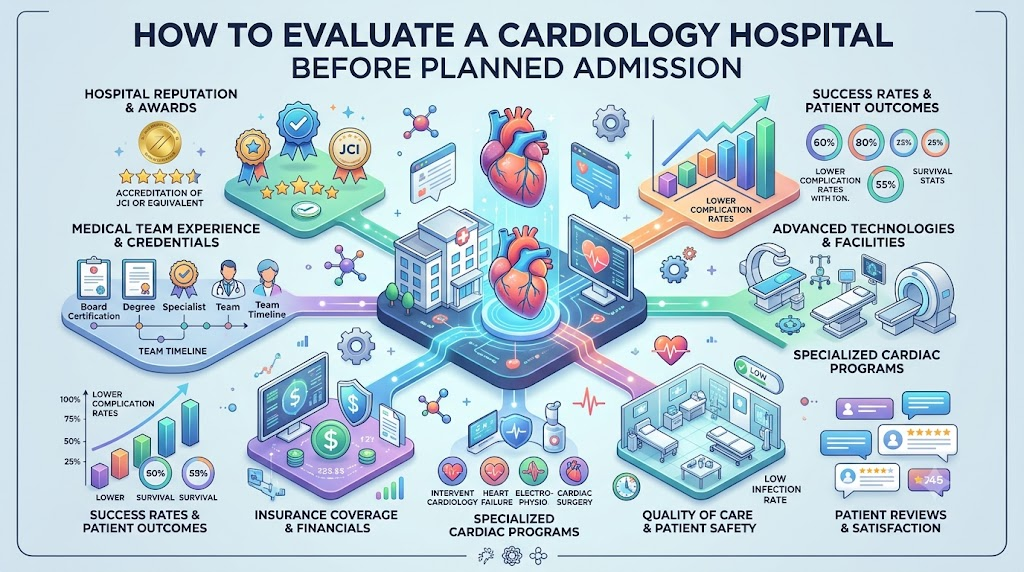
Introduction
Choosing a heart hospital is an important step before planned treatment. The right choice depends on your heart condition, medical needs, and care plan. A famous name alone does not guarantee suitable care.
Knowing how to evaluate a cardiology hospital before admission can help you make an informed choice. This article explains how to compare cardiologists, cardiac facilities, patient safety, treatment options, costs, and follow-up care. You can begin your research at Bestcardiachospitals and then contact hospitals to confirm their services.
Use these practical checks to prepare questions before admission. Always discuss your needs with a qualified healthcare professional.
Why Evaluate a Cardiology Hospital Before Admission?
Heart care can involve tests, medicines, procedures, or surgery. Each hospital may offer a different range of services. Some focus on routine heart tests, while others provide complex heart surgery.
Your choice can affect how your care is planned and delivered. Specialist experience, trained staff, and suitable equipment all matter. Emergency support and follow-up services are also important.
A large building or famous name does not guarantee the right care. Focus on your diagnosis and the services you may need. Ask clear questions before making a planned admission decision.
Understand Your Heart Condition and Treatment Needs
First, ask your doctor to explain your heart condition in simple words. Learn which tests or treatments may be needed. This will help you compare hospitals fairly.
Common reasons for cardiology admission include:
- Coronary artery disease: Narrowing of the blood vessels that supply the heart.
- Heart rhythm problems: A heartbeat that is too fast, slow, or uneven.
- Heart valve disease: A problem with the valves that control blood flow.
- Heart failure: A condition where the heart cannot pump blood well enough.
- Congenital heart conditions: Heart problems present from birth.
- Heart attacks and related problems: Conditions that may need urgent or planned care.
- Planned heart surgery: Assessment before an operation to treat a heart problem.
- Angioplasty or bypass assessment: Checks before a procedure to improve blood flow.
Some patients need medicines and regular checks. Others may need angioplasty, a device, or surgery. The right plan depends on the diagnosis and overall health.
Ask your doctor which services your case may require. Do not delay urgent care to compare hospitals. Sudden or severe heart symptoms need prompt medical assessment.
Check the Qualifications and Experience of Cardiologists
The treating team should have training that matches your heart condition. Ask who will lead your care and who will perform any planned procedure. Confirm the doctor’s details directly with the hospital or relevant professional authority.
Check these points before admission:
- Relevant medical qualifications and specialist registration, where required.
- Experience treating your specific heart condition.
- Experience with the proposed procedure, if one is planned.
- Access to other heart specialists when needed.
- Clear explanations of treatment choices and risks.
- Availability for reviews after discharge.
Different specialists have different roles. A cardiologist diagnoses and treats heart conditions, often with medicines and tests. An interventional cardiologist performs procedures such as angioplasty and stent placement. A cardiac surgeon performs operations on the heart and nearby blood vessels.
Ask whether the proposed doctor will manage your care throughout admission. Also ask who will answer questions if that doctor is unavailable. Do not rely only on online claims or promotional material.
Evaluate Cardiac Diagnostic Facilities
Heart tests help doctors understand how the heart works. The tests needed depend on your symptoms, diagnosis, and planned treatment. Not every patient needs every test.
Ask whether the hospital offers the tests your doctor expects, such as:
- Electrocardiogram (ECG): Records the heart’s electrical activity.
- Echocardiogram: Uses sound waves to show the heart’s structure and movement.
- Exercise stress test: Checks the heart during physical activity, when suitable.
- Holter monitoring: Records heart rhythm over a longer period.
- Cardiac CT or MRI: Provides detailed images of the heart.
- Coronary angiography: Uses imaging to examine the heart’s blood vessels.
- Blood tests: Check for signs of heart injury and other health concerns.
Ask whether each required test is available on-site. If not, ask how the hospital arranges it elsewhere. Confirm how results reach your treating doctor and how long they may take.
Check Emergency and Intensive Care Support
Heart conditions can sometimes change quickly. A suitable hospital should have emergency support that matches the care it provides. Ask which services are available at the exact hospital location.
Check whether the hospital has:
- Emergency assessment at all hours.
- A cardiac intensive care unit, also called a cardiac ICU.
- Nurses trained in cardiac care.
- Equipment to monitor heart rhythm.
- Equipment for emergency resuscitation.
- Access to urgent cardiac procedures when indicated.
- Support for patients who need breathing help or close monitoring.
A cardiac ICU provides close monitoring for seriously ill heart patients. Staff can watch vital signs and respond to changes. However, not every cardiology hospital offers every advanced service.
Ask how the hospital handles sudden complications. If a needed service is not available, ask about its referral or transfer process. Choose a facility that can meet your likely needs.
Assess the Hospital’s Treatment Options
A cardiac care hospital should offer treatment that fits your diagnosis. Ask the treating team which options may apply to your case. Do not assume every hospital performs every procedure.
Possible treatment options include:
- Medicines and ongoing medical care.
- Angioplasty and stent placement to improve blood flow.
- Coronary artery bypass surgery.
- Heart valve repair or replacement.
- Treatment for heart rhythm disorders.
- Pacemakers and other heart devices.
- Cardiac rehabilitation to support recovery.
- Specialist care for heart failure.
The best option depends on your condition, risks, and general health. Ask about expected benefits, possible complications, and other choices. Find out what recovery may involve and whether you will need help at home.
You can also ask who will explain the final treatment plan. Make sure you understand why a treatment is being suggested. Seek a second medical opinion when appropriate and practical.
Review Patient Safety and Hospital Standards
Patient safety should be part of every hospital check. Ask how the hospital prevents infections and handles medicines. You can also ask how staff confirm a patient’s identity before tests or treatment.
Check the following:
- Current hospital registration, where required.
- Relevant accreditation and what it covers.
- Infection prevention and cleaning practices.
- Safe storage and handling of medicines.
- Patient identification checks.
- Clear consent forms and treatment explanations.
- Safe blood transfusion services, when needed.
- Procedures for managing complications.
Accreditation may provide useful information about hospital standards. Yet it does not prove that every service is right for every patient. Confirm any claimed accreditation with the relevant authority.
Ask how staff explain risks before a procedure. You should have a chance to ask questions and understand the plan. In emergencies, treatment may need to begin before a full discussion is possible.
Understand the Hospital Admission Process
Before planned admission, ask the hospital what steps you must complete. The process can differ by hospital and treatment. Knowing the steps can reduce confusion on admission day.
You may need to arrange:
- The doctor’s advice or admission letter.
- Registration and identity checks.
- Your medical history and current medicine list.
- Earlier heart reports and test results.
- Pre-admission tests, if required.
- Consent forms and treatment discussions.
- Insurance papers and payment details.
- The planned admission date and expected stay.
Ask whether you need to fast or follow other instructions before admission. Follow only instructions given by your healthcare team. Do not stop prescribed medicines unless your healthcare team tells you to do so.
Confirm when to arrive and where to report. Ask whom to contact if your symptoms change before admission. Tell your care team about new symptoms or changes in your health.
What to Check Before Choosing a Cardiology Hospital
| Factor | What to Check | Why It Matters |
|---|---|---|
| Cardiology team | Relevant qualifications and experience | Helps assess specialist suitability |
| Diagnostic facilities | Tests needed for your condition | Supports proper assessment |
| Emergency care | Cardiac emergency and ICU support | Helps prepare for urgent needs |
| Treatment options | Required procedures and specialist services | Matches care to your diagnosis |
| Patient safety | Hospital standards and infection control | Supports safer care |
| Follow-up | Reviews and rehabilitation services | Supports ongoing recovery |
Compare Treatment Costs and Insurance Coverage
Ask for a written cost estimate before planned admission. A clear estimate helps you understand the likely financial needs. The final bill may change if your treatment or length of stay changes.
Ask whether the estimate includes:
- Specialist consultations and diagnostic tests.
- Room charges and nursing care.
- Medicines and medical supplies.
- Procedures or surgery.
- Intensive care, if needed.
- Implants or cardiac devices.
- Discharge medicines and follow-up visits.
Ask which extra charges may apply. These may include added tests, longer stays, or care for complications. Request an itemized estimate so you can review each charge.
Insurance coverage depends on your policy and hospital network. Confirm pre-authorization, exclusions, room limits, co-payments, and other conditions with your insurer. Ask the hospital’s billing team which documents they need and how claims are handled.
Do not choose a hospital based on price alone. Compare the required services, specialist support, safety checks, and follow-up care too.
Review Communication and Patient Support
Clear communication helps patients make informed choices. The hospital team should explain the diagnosis and treatment plan in words you understand. You should be able to raise concerns before giving consent, unless emergency care requires immediate action.
Check whether staff can:
- Explain treatment choices, benefits, and risks.
- Answer questions in a clear way.
- Provide written instructions when needed.
- Explain how family members can receive updates.
- Offer language support, when available.
- Explain how to request medical records.
Ask how to contact the team before and after admission. Confirm whether you will receive a copy of your test results and discharge plan. These details can help you stay informed throughout care.
Plan Recovery and Follow-Up Care
Heart care does not end when you leave the hospital. You may need medicine reviews, follow-up visits, wound care, or cardiac rehabilitation. The exact plan depends on your diagnosis and treatment.
Before admission, ask:
- How long might I stay in the hospital?
- What help might I need at home?
- When should I return for follow-up?
- Which symptoms need urgent medical attention?
- How can I contact the care team after discharge?
Ask whether rehabilitation is suitable for you. It may help some patients build strength and manage risk factors. Recovery times vary, so avoid relying on a fixed timeline.
Get written instructions before leaving the hospital. Make sure you understand your medicines and follow-up dates. Ask a family member or caregiver to help if you need support.
Prepare a Cardiology Hospital Admission Checklist
Use this hospital admission checklist to prepare for a planned stay. Confirm the exact requirements with the hospital before you leave home.
- Medical reports and recent test results.
- Previous ECGs, echocardiograms, and angiography reports, if available.
- Current prescriptions and a complete medicine list.
- Details of allergies and other health conditions.
- Identification and insurance documents.
- The doctor’s admission advice.
- Contact details for family members or caregivers.
- Questions about treatment, costs, and recovery.
Keep important papers together in a folder. Carry your medicines list even if the hospital asks you to bring medicine packs. Follow the hospital’s own instructions about medicines and personal items.
When Should You Seek Emergency Cardiac Care?
Some heart symptoms need immediate medical assessment. Do not wait for a planned admission or finish comparing hospitals if warning signs appear.
Seek emergency help for symptoms such as:
- Chest pain, pressure, or tightness.
- Severe or sudden shortness of breath.
- Fainting or collapse.
- Cold sweating with chest discomfort.
- Pain spreading to the arm, back, neck, or jaw.
- Sudden weakness, facial drooping, or trouble speaking.
Call your local emergency services if you suspect a heart attack or stroke. Follow the emergency team’s instructions. Do not drive yourself if you may be having a serious cardiac event.
How BestCardiacHospitals.com Can Help Readers
BestCardiacHospitals.com can be a starting point for exploring cardiac hospital information. Use available details to prepare a shortlist and questions for each hospital. Then contact the hospital to confirm its doctors, services, costs, and admission process.
Treat online information as a starting point, not a guarantee of quality. Your own doctor can help you understand which services your condition may require. Confirm important details directly before making a planned admission decision.
Frequently Asked Questions
1. How do I evaluate a cardiology hospital before admission?
Check specialist experience, required tests, emergency support, treatment options, safety standards, costs, and follow-up care. Confirm details with the hospital and your doctor.
2. What qualifications should a cardiologist have?
A cardiologist should have suitable medical training and relevant specialist credentials. Confirm registration and experience through the hospital or appropriate professional authority.
3. Which cardiac facilities should I check before admission?
Ask about the tests and services your condition may require. These may include ECG, echocardiography, rhythm monitoring, angiography, or cardiac imaging.
4. Why is a cardiac ICU important?
A cardiac ICU provides close monitoring for seriously ill heart patients. It supports rapid response when a patient’s condition changes.
5. How can I check a hospital’s cardiac treatment options?
Ask the hospital which treatments it offers for your diagnosis. Confirm whether the required specialists and procedures are available at that location.
6. What documents should I bring for hospital admission?
Bring medical reports, test results, prescriptions, allergy details, identification, insurance papers, and your admission advice. Confirm the full list with the hospital.
7. How can I compare cardiology hospital costs?
Request written, itemized estimates from hospitals. Check what each estimate includes and ask about extra charges, devices, intensive care, and follow-up visits.
8. Does health insurance cover cardiac treatment?
Coverage depends on your policy, hospital network, and treatment. Ask your insurer about pre-authorization, exclusions, co-payments, and room limits.
9. What questions should I ask before heart surgery?
Ask why surgery is advised, what benefits and risks it has, and whether alternatives exist. Discuss recovery, likely costs, and follow-up care with your surgeon.
10. When should I seek emergency cardiac care instead of planned admission?
Seek emergency help for chest pain, severe breathlessness, fainting, or possible stroke symptoms. Call local emergency services rather than waiting to compare hospitals.
Conclusion
Evaluating a cardiology hospital before planned admission takes careful questions and clear information. Compare the medical team, needed facilities, safety practices, treatment options, costs, and follow-up care. Confirm key details directly with the hospital and discuss your needs with your doctor.
The right hospital depends on your diagnosis and the care you may need. This article provides general education and does not replace advice from a qualified healthcare professional.