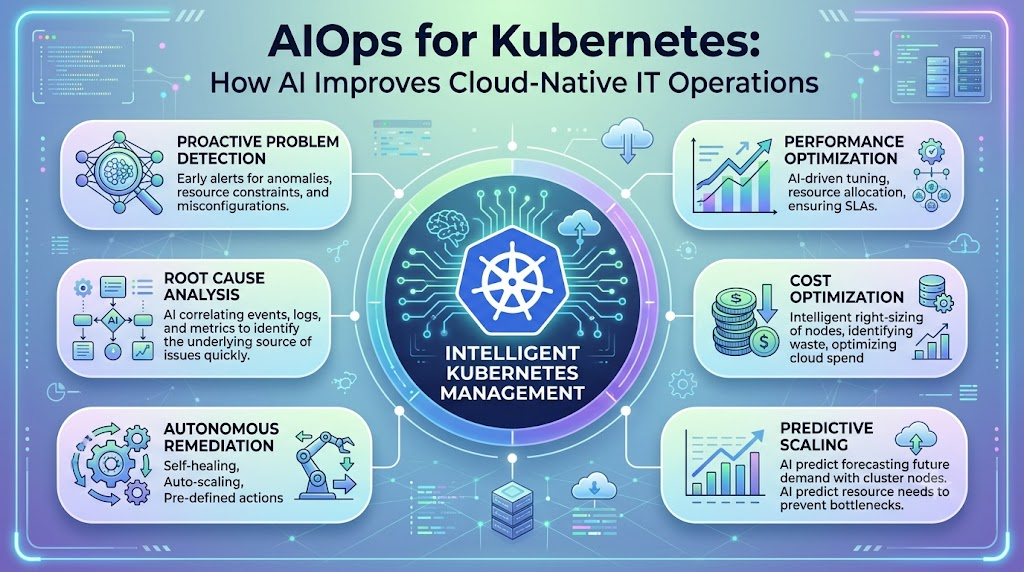
Introduction
Kubernetes makes it possible to run complex applications across clusters, containers, services, and cloud infrastructure, but that flexibility also creates an operational challenge. A single application issue can generate signals from pods, nodes, APIs, databases, networks, and monitoring systems at the same time. Engineers may spend valuable time connecting those signals instead of resolving the actual problem.
This is where AIOps for Kubernetes can add an intelligent operational layer. By applying Artificial Intelligence for IT Operations to Kubernetes telemetry, teams can identify unusual behavior, correlate events, prioritize incidents, and support faster investigation. TheAIOps explores the concepts, skills, and technologies behind intelligent IT operations.
What Is AIOps for Kubernetes?
AIOps for Kubernetes combines Kubernetes observability data with artificial intelligence, machine learning, analytics, and automation.
Kubernetes already produces large amounts of operational information, including pod events, container logs, resource metrics, deployment changes, node conditions, and service activity. An AIOps approach analyzes these signals together rather than treating every alert as an independent problem.
For example, a sudden increase in application latency might be related to a resource-constrained pod, a recent deployment, database connection problems, or node-level issues. AIOps can help connect these signals and provide additional context for investigation.
The goal is not to replace engineers. Instead, it is to reduce repetitive investigation and provide better operational intelligence.
Why Kubernetes Needs Intelligent Operations
Traditional monitoring often works well for individual metrics or predefined thresholds. Kubernetes environments, however, can change rapidly.
Pods may be created and removed automatically. Services can move between nodes, deployments can introduce new versions, and autoscaling can change resource consumption. Microservices also create dependencies that are difficult to understand from isolated alerts.
AIOps can add capabilities such as:
- Anomaly detection
- Event correlation
- Root-cause analysis support
- Predictive analytics
- Alert prioritization
- Incident management
- Automated remediation
These capabilities can help operations teams move from simply detecting symptoms toward understanding relationships between operational signals.
How AIOps Works With Kubernetes Observability
Kubernetes observability typically involves three major telemetry types: metrics, logs, and traces.
Metrics can show CPU utilization, memory consumption, request rates, latency, and other numerical conditions. Logs provide detailed application and infrastructure messages. Traces help engineers follow requests as they move through distributed services.
An AIOps Platform can bring these sources together with Kubernetes events and other operational data.
1. Data Collection
The first step is collecting relevant information from clusters, applications, cloud services, databases, networks, and monitoring systems.
Data quality matters. Missing timestamps, inconsistent service names, or incomplete metadata can reduce the usefulness of later analysis.
2. Event Correlation
Instead of presenting hundreds of alerts separately, correlation identifies signals that may belong to the same operational incident.
For example, a failed deployment could produce container restart alerts, increased API errors, latency spikes, and service availability warnings. Correlation can group these related signals into a more useful incident context.
3. Anomaly Detection
Machine learning can establish patterns of normal behavior and identify unusual activity.
An anomaly does not automatically mean something is broken. It is a signal that deserves investigation. Engineers should consider application changes, traffic patterns, maintenance activities, and other context before taking action.
4. Root-Cause Analysis
AIOps can examine relationships between Kubernetes resources and operational events to help identify likely causes.
It may connect a service degradation with a recent deployment, node resource pressure, or a dependency failure. The resulting analysis should be treated as evidence for investigation rather than an unquestionable diagnosis.
Practical Kubernetes AIOps Example
Imagine a production application running across several Kubernetes services.
A new version is deployed. Shortly afterward, API latency increases, several containers restart, and database connection errors appear.
A traditional monitoring environment may produce multiple alerts for each symptom. An AIOps workflow can analyze the timing and relationships between those signals.
| Kubernetes Signal | AIOps Analysis | Operational Response |
|---|---|---|
| Container restarts | Detects abnormal restart pattern | Investigate affected workloads |
| API latency spike | Correlates latency with deployment timing | Examine new application version |
| Database errors | Links dependency failures with service behavior | Validate database connections and application changes |
The resulting incident view gives engineers more context before they begin remediation.
AIOps Tools for Kubernetes Operations
The right combination of AIOps Tools depends on an organization’s architecture and operational requirements.
A useful technology stack may include Kubernetes-native monitoring, centralized logging, distributed tracing, cloud monitoring, incident management systems, and automation platforms.
When evaluating an AIOps solution, consider:
- Kubernetes and cloud integrations
- Metrics, logs, and trace support
- Event correlation
- Anomaly detection
- Incident management integration
- APIs and automation capabilities
- Scalability
- Security and access controls
- Deployment options
- Governance and auditability
An AIOps Platform should fit the existing operational ecosystem rather than create another isolated monitoring environment.
A Practical AIOps Implementation Approach
A successful AIOps Implementation should begin with a specific operational problem.
Start by identifying issues such as excessive alert noise, slow incident investigation, repeated Kubernetes failures, or manual remediation tasks.
Next, review the available telemetry and determine whether important data sources are missing. Integrate the highest-value sources first instead of attempting to connect everything simultaneously.
After that, introduce correlation and anomaly detection for selected use cases. Measure whether the system is producing useful signals and whether engineers can understand why an alert or recommendation was generated.
Automation should come later. Begin with low-risk actions and require human approval for changes that could have significant production impact.
Benefits and Challenges
AIOps can improve Kubernetes operations by providing broader visibility across infrastructure and applications. It may reduce repetitive investigation, improve incident prioritization, identify unusual behavior earlier, and support more consistent operational workflows.
However, implementation has limitations.
Poor telemetry quality can lead to weak analysis. Incorrect correlations can mislead responders, while excessive automation can introduce operational risk. Teams also need appropriate governance, skilled engineers, and clear ownership of automated actions.
AIOps should therefore complement strong observability and operational practices rather than compensate for poorly designed monitoring.
Security and Governance for Automated Remediation
Automated actions require careful controls, particularly in production Kubernetes clusters.
Access should follow the principle of least privilege. Service accounts and automation systems should receive only the permissions they actually require.
Teams should also maintain audit logs, approval processes, testing environments, rollback procedures, and monitoring for automated actions.
For example, automatically restarting a non-critical workload may be relatively low risk, while changing production networking or scaling critical infrastructure requires stronger validation and approval.
Human oversight remains valuable when an automated system has low confidence or encounters an unfamiliar situation.
Skills Needed for Kubernetes AIOps
Professionals pursuing AIOps Training or an AIOps Course can benefit from learning Kubernetes fundamentals alongside observability, cloud infrastructure, automation, incident management, and basic machine learning concepts.
An AIOps Engineer may work across monitoring, data analysis, automation, infrastructure, and reliability workflows. The exact responsibilities vary between organizations.
An AIOps Certification may demonstrate knowledge of relevant concepts, but professionals should also develop practical skills through hands-on labs and real operational scenarios.
Organizations may use AIOps Consulting or AIOps Services when they need help assessing architecture, selecting capabilities, integrating data sources, or developing an implementation strategy.
Best Practices for Kubernetes AIOps
A practical approach includes:
- Start with measurable operational problems.
- Maintain high-quality telemetry.
- Establish clear service ownership.
- Use correlation to reduce unnecessary noise.
- Validate AI-generated recommendations.
- Introduce automation gradually.
- Keep human approval for high-risk actions.
- Measure false positives and false negatives.
- Review automated actions regularly.
- Continuously improve models and operational workflows.
The objective should be better decisions and safer automation, not simply adding AI to an existing monitoring stack.
Frequently Asked Questions
1. What is AIOps for Kubernetes?
AIOps for Kubernetes applies AI, machine learning, analytics, and automation to Kubernetes operational data. It can support monitoring, anomaly detection, event correlation, incident management, and remediation.
2. How does AIOps improve Kubernetes monitoring?
It can analyze signals from multiple sources and identify relationships between events. This gives engineers more context than isolated metric or alert monitoring.
3. Can AIOps automatically fix Kubernetes problems?
It can support automated remediation for predefined situations, but automation should include appropriate validation, permissions, monitoring, and rollback controls.
4. What Kubernetes data can AIOps analyze?
Depending on the implementation, AIOps may analyze metrics, logs, traces, Kubernetes events, deployment information, infrastructure telemetry, and application monitoring data.
5. Does AIOps replace Kubernetes engineers?
No. AIOps is designed to assist engineers by reducing repetitive work and providing operational insights. Human expertise remains important for complex diagnosis and high-risk decisions.
6. What is Kubernetes observability?
Kubernetes observability is the practice of understanding system behavior through telemetry such as metrics, logs, traces, and events. It provides the operational data that AIOps capabilities can analyze.
7. What should organizations consider when selecting AIOps Tools?
They should evaluate integrations, observability support, event correlation, anomaly detection, automation, scalability, security, APIs, governance, and compatibility with existing systems.
8. Is AIOps useful for microservices running on Kubernetes?
Yes. Microservices generate distributed operational signals, and AIOps can help correlate those signals across services, infrastructure, dependencies, and applications.
9. What should beginners learn before starting AIOps Training?
Basic Kubernetes, cloud infrastructure, monitoring, observability, networking, incident management, scripting, and automation provide a useful foundation.
10. How should organizations begin an AIOps Implementation?
Start with a clearly defined operational problem, assess existing telemetry, select a focused use case, integrate relevant data, test analytics, establish governance, and introduce automation gradually.
Conclusion
AIOps for Kubernetes provides an intelligent layer for managing increasingly dynamic cloud-native environments. By combining observability with anomaly detection, event correlation, analytics, and controlled automation, teams can gain better context around operational problems and reduce repetitive investigation. Success depends on reliable telemetry, thoughtful implementation, strong security controls, and human oversight. For professionals, building Kubernetes, observability, automation, and AI skills can create a strong foundation for working with modern intelligent IT operations.