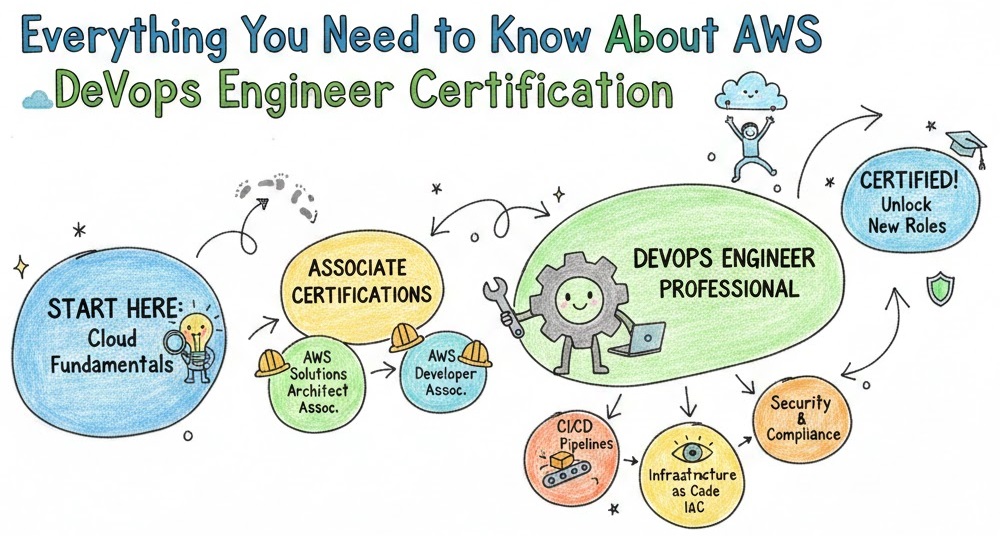
Introduction
The role of a DevOps Engineer has become crucial in today’s fast-paced, cloud-driven world. As organizations increasingly adopt cloud technologies to improve scalability, agility, and cost-effectiveness, there is a growing demand for professionals skilled in cloud infrastructure management, automation, and security. The AWS DevOps Engineer – Professional certification is one of the most prestigious certifications in the cloud domain, designed for those who want to specialize in managing and automating the deployment of applications in the AWS cloud environment.This guide will provide a comprehensive overview of the AWS DevOps Engineer – Professional certification, including its prerequisites, the skills you will gain, preparation tips, and potential career outcomes.
What is AWS DevOps Engineer – Professional?
The AWS DevOps Engineer – Professional certification is an advanced-level certification designed for individuals who have experience with AWS and DevOps practices. It focuses on the ability to provision, operate, and manage AWS environments with continuous integration, delivery, and deployment in mind. The exam tests your skills in designing and implementing scalable, highly available, and fault-tolerant systems on AWS while using automation tools like AWS CloudFormation, CodePipeline, and other AWS DevOps services.
This certification demonstrates to employers that you have mastered cloud infrastructure management and can efficiently work with DevOps tools and AWS services to build, deploy, and maintain applications in a scalable cloud environment.
Who Should Take This Certification?
The AWS DevOps Engineer – Professional certification is intended for individuals who have experience in:
- DevOps Engineering: If you are already working in a DevOps environment, this certification will enhance your skills in automating operations and improving application delivery.
- Cloud Engineering: Cloud professionals who already manage AWS resources and are looking to deepen their understanding of AWS DevOps practices.
- Systems Operations: If you are working as a Systems Administrator or DevOps Specialist and want to expand your capabilities with AWS.
- Application Development: Software developers aiming to integrate application development practices with AWS infrastructure and continuous delivery pipelines.
Prerequisites
- AWS Certified Developer – Associate or AWS Certified SysOps Administrator – Associate: These certifications are recommended but not mandatory.
- Experience: You should have at least two years of hands-on experience managing AWS workloads and automating DevOps processes.
- DevOps Experience: Understanding core DevOps practices, like continuous integration (CI), continuous delivery (CD), and infrastructure as code (IaC), is essential.
Skills You’ll Gain
Achieving this certification provides in-depth knowledge of AWS services, along with specialized DevOps practices that are crucial for managing modern cloud environments. Here are some of the core skills you will acquire:
- Infrastructure as Code (IaC): Automate the provisioning and management of AWS resources using AWS CloudFormation or other IaC tools.
- Continuous Integration & Continuous Delivery (CI/CD): Build and manage CI/CD pipelines using AWS services like CodePipeline, CodeCommit, and CodeBuild to streamline the development lifecycle.
- Monitoring and Logging: Utilize AWS CloudWatch, CloudTrail, and other monitoring tools to track system performance, detect issues, and optimize applications.
- Security Best Practices: Integrate security at every stage of the DevOps pipeline using AWS IAM, KMS, and AWS Shield.
- Automating Testing and Deployment: Automate testing and deployment using tools like AWS CodeDeploy and Lambda to ensure fast, efficient, and consistent releases.
Real-World Projects You Should Be Able to Do After It
By obtaining the AWS DevOps Engineer – Professional certification, you will be ready to tackle a variety of real-world challenges, such as:
- Automated Infrastructure Management: Using IaC tools like AWS CloudFormation, you can automate the provisioning and configuration of servers, databases, and networking components in a repeatable, predictable way.
- CI/CD Pipeline Setup: Design and implement a fully automated CI/CD pipeline for code integration, testing, and deployment across different environments, including production.
- Cloud Security Implementation: Implement AWS security best practices, including IAM policies, encrypted storage, and secure networking, to ensure the integrity and confidentiality of cloud applications.
- Scaling and Performance Optimization: Using AWS Auto Scaling and Elastic Load Balancing, you can configure systems that automatically scale based on demand, optimizing resource usage and reducing costs.
- Monitoring and Incident Management: Set up monitoring solutions with AWS CloudWatch and integrate alerts to notify engineers of performance anomalies, system failures, or breaches.
Preparation Plan
Here’s a structured preparation plan to help you succeed:
7-14 Days:
- Review AWS Basics: Brush up on essential AWS services such as EC2, S3, IAM, and Lambda. Review AWS Well-Architected Framework and DevOps principles.
- Hands-on Labs: Spend time on AWS to get familiar with services like CloudFormation, CodePipeline, CodeBuild, and CloudWatch.
30 Days:
- Deep Dive into AWS DevOps Services: Focus on services like CodeDeploy, Elastic Beanstalk, and Lambda for automation and CI/CD.
- Create Small Projects: Build simple DevOps pipelines, deploy applications, and set up automated scaling.
60 Days:
- Advanced Topics: Focus on high-availability architectures, complex security implementations, and advanced monitoring strategies.
- Mock Exams: Take practice exams to gauge your readiness and review all weak areas.
Common Mistakes
Many candidates make common mistakes while preparing for the AWS DevOps Engineer – Professional exam. Here are some to watch out for:
- Skipping Hands-On Practice: AWS is a practical platform, so understanding concepts in theory without applying them won’t be enough.
- Not Reviewing the Exam Blueprint: Make sure to review the AWS exam guide and understand the weightage of each topic to focus on the right areas.
- Underestimating Security: Many candidates focus on CI/CD and automation but overlook the importance of security, which is a core aspect of the exam.
Best Next Certification After This
After completing the AWS DevOps Engineer – Professional, you can further your career by pursuing one of the following certifications:
- Same Track: AWS Certified Solutions Architect – Professional: Deepen your cloud architecture knowledge and move into advanced cloud design.
- Cross-Track: AWS Certified Security – Specialty: Focus on cloud security, an area that is becoming increasingly important in DevOps workflows.
- Leadership: AWS Certified Cloud Practitioner: For those looking to expand into broader cloud management and leadership roles.
Choose Your Path
After earning your AWS DevOps Engineer – Professional certification, you can explore various career paths in cloud and DevOps engineering:
1. DevOps
Focus on automating development and operations to improve delivery pipelines and system reliability.
- Roles: DevOps Engineer, Cloud Engineer
- Skills: CI/CD, automation, infrastructure as code
2. DevSecOps
Integrate security practices into the DevOps process to ensure secure application delivery.
- Roles: DevSecOps Engineer, Cloud Security Engineer
- Skills: Security integration, vulnerability scanning, encryption
3. Site Reliability Engineering (SRE)
Ensure high system reliability, scalability, and performance with automation and monitoring.
- Roles: SRE, Performance Engineer
- Skills: Monitoring, automation, fault tolerance
4. AIOps/MLOps
Use AI/ML to automate and optimize operational tasks and IT workflows.
- Roles: AIOps Engineer, MLOps Engineer
- Skills: Machine learning, anomaly detection, predictive analysis
5. DataOps
Streamline data workflows and automate data pipeline management for analytics and ML.
- Roles: Data Engineer, DataOps Engineer
- Skills: Data pipeline automation, ETL, cloud data storage
6. FinOps
Optimize and manage cloud financial operations to control costs and maximize ROI.
- Roles: FinOps Practitioner, Cloud Financial Manager
- Skills: Cloud cost management, budgeting, financial governance
Role → Recommended Certifications
| Role | Recommended Certifications |
|---|---|
| DevOps Engineer | AWS DevOps Engineer – Professional, Kubernetes Certified Engineer |
| SRE | AWS Certified Solutions Architect – Professional, Google Cloud DevOps Engineer |
| Platform Engineer | AWS DevOps Engineer – Professional, Kubernetes Certified Administrator |
| Cloud Engineer | AWS Certified Solutions Architect – Associate, AWS Certified SysOps Administrator |
| Security Engineer | AWS Certified Security – Specialty, AWS Certified Solutions Architect – Professional |
| Data Engineer | AWS Certified Data Analytics – Specialty, AWS Certified Solutions Architect |
| FinOps Practitioner | AWS Certified FinOps Practitioner, AWS Certified Solutions Architect |
| Engineering Manager | AWS Certified Cloud Practitioner, AWS Certified Solutions Architect – Professional |
Top Institutions Providing AWS DevOps Engineer – Professional Training & Certifications
These institutions offer comprehensive training programs designed to help you achieve the AWS DevOps Engineer – Professional certification. Each institution is known for its hands-on training, expert instructors, and tailored curriculum to ensure your success. Below are some of the best options:
1. DevOpsSchool
DevOpsSchool is a renowned platform for DevOps training and certification, offering in-depth, hands-on training in AWS DevOps concepts. They focus on practical labs, real-world scenarios, and exam preparation strategies. With instructor-led sessions and flexible learning paths, DevOpsSchool ensures you gain the skills needed to automate infrastructure, manage CI/CD pipelines, and master AWS tools such as CodePipeline, CodeDeploy, and CloudFormation.
- Why Choose Them: Hands-on labs, globally recognized certifications, expert instructors, live project experience.
- Key Offerings: AWS DevOps Engineer training, AWS certified solutions, cloud automation, and CI/CD pipeline implementation.
2. Cotocus
Cotocus provides advanced AWS DevOps training with a focus on practical applications in cloud automation, CI/CD pipeline creation, and monitoring using AWS services. Their curriculum is designed for professionals looking to deepen their AWS expertise and includes real project work to give you the experience necessary to pass the certification exam. Cotocus also offers extensive career support and personalized learning options.
- Why Choose Them: Real-world project integration, career assistance, hands-on labs, and AWS exam preparation.
- Key Offerings: CI/CD implementation, AWS DevOps best practices, cloud automation, real-world scenarios.
3. ScmGalaxy
ScmGalaxy is a trusted training provider known for offering in-depth training on AWS DevOps practices and cloud automation. They cover a range of DevOps tools and technologies and provide certification preparation courses for AWS DevOps Engineer – Professional. With live sessions and comprehensive course materials, they equip students with the skills needed to work with AWS infrastructure and manage complex cloud systems.
- Why Choose Them: Focus on bridging theoretical concepts with industry expectations, hands-on practice, and exam-specific guidance.
- Key Offerings: Cloud automation, AWS infrastructure management, hands-on labs with AWS services like CodeDeploy, and S3.
4. BestDevOps
BestDevOps is focused on providing high-quality DevOps training and certification for professionals. Their AWS DevOps program includes expert-level training on automating cloud services, integrating security into DevOps practices (DevSecOps), and utilizing AWS tools to create scalable, fault-tolerant applications. BestDevOps offers both self-paced and instructor-led learning, along with personalized mentorship.
- Why Choose Them: Real-world use cases, expert instructors, practical labs, and ongoing mentorship.
- Key Offerings: Cloud infrastructure management, CI/CD pipeline creation, automated testing, and security integration.
5. DevSecOpsSchool
DevSecOpsSchool specializes in DevSecOps, a combination of DevOps and security practices. Their AWS DevOps training incorporates security automation from the very beginning, ensuring that learners not only understand DevOps but also implement security best practices using AWS services like IAM, KMS, and GuardDuty. This is ideal for those who want to integrate security into their DevOps workflows.
- Why Choose Them: Security-first approach, emphasis on DevSecOps, practical labs, and security-focused AWS tools.
- Key Offerings: Security integration into CI/CD pipelines, automation of security testing, identity and access management (IAM).
6. SRESchool
SRESchool is dedicated to Site Reliability Engineering (SRE) and offers training for AWS DevOps roles that also incorporate SRE principles. SREs focus on building and maintaining reliable, scalable, and efficient systems, making this training ideal for professionals looking to specialize in cloud reliability. The curriculum includes AWS tools for automation, monitoring, incident management, and system performance.
- Why Choose Them: Focus on scalability, reliability, and fault-tolerant architectures in the cloud.
- Key Offerings: Monitoring, incident management, disaster recovery, and automation for AWS environments.
7. AIOpsSchool
AIOpsSchool focuses on the intersection of AI and operations, training professionals to use artificial intelligence and machine learning to enhance IT operations. Their AWS DevOps training integrates AIOps with traditional DevOps practices to enable smarter automation, predictive analytics, and anomaly detection using AWS services like CloudWatch and AWS Lambda.
- Why Choose Them: Advanced automation using AI and ML, predictive analytics, and cutting-edge DevOps practices.
- Key Offerings: Machine learning integration in DevOps, AI-driven monitoring and automation, real-time anomaly detection.
8. DataOpsSchool
DataOpsSchool specializes in DataOps, which combines data engineering, operations, and DevOps practices to improve data pipeline automation and delivery. Their AWS DevOps training emphasizes efficient management and orchestration of data in cloud environments, using AWS tools to create scalable and automated data workflows for real-time analytics.
- Why Choose Them: Expertise in data engineering and cloud automation for data-centric organizations.
- Key Offerings: Data pipeline automation, cloud data management with AWS, integration of DevOps and DataOps practices.
9. FinOpsSchool
FinOpsSchool specializes in FinOps—a cloud financial operations discipline that focuses on managing and optimizing cloud spending. Their AWS DevOps certification training helps professionals learn how to integrate financial practices with DevOps, making it ideal for those who want to work on cost optimization and financial governance within cloud platforms like AWS.
- Why Choose Them: Unique focus on cloud cost management, budgeting, and optimization.
- Key Offerings: Cloud cost monitoring, financial optimization for DevOps teams, AWS pricing models, budgeting strategies.
Comparison Table: AWS DevOps Engineer – Professional vs Other AWS Certifications
| Certification | Track | Level | Who it’s For | Prerequisites | Skills Covered | Recommended Order |
|---|---|---|---|---|---|---|
| AWS Certified DevOps Engineer – Professional | DevOps | Professional | DevOps Engineers, Cloud Engineers, Automation Experts | AWS Certified Developer – Associate or SysOps Associate (Recommended) | Infrastructure as Code (IaC), CI/CD pipelines, security integration, automation, monitoring, logging | AWS Certified Developer – Associate → DevOps Engineer |
| AWS Certified Solutions Architect – Professional | Cloud Architecture | Professional | Solution Architects, Cloud Architects | AWS Certified Solutions Architect – Associate | Advanced architecture, cloud services design, high availability, disaster recovery, security | AWS Certified Solutions Architect – Associate → Professional |
| AWS Certified Security – Specialty | Security | Specialty | Security Engineers, Cloud Security Experts | AWS Certified Cloud Practitioner (Recommended) | Cloud security best practices, encryption, identity and access management, risk management | AWS Certified DevOps Engineer → Security Specialty |
| AWS Certified Developer – Associate | Development | Associate | Software Developers, Cloud Developers | None (Recommended: Basic AWS knowledge) | AWS services for app development, deployment, testing, troubleshooting, monitoring | AWS Certified Solutions Architect → Developer |
| AWS Certified SysOps Administrator – Associate | Operations | Associate | Systems Administrators, Cloud Operators | None (Recommended: Basic AWS knowledge) | Cloud infrastructure management, monitoring, automation, system scaling, security | AWS Certified Developer → SysOps Administrator |
| AWS Certified Cloud Practitioner | Cloud Fundamentals | Foundational | Beginners, Sales Professionals, Newcomers to Cloud Technology | None | Core AWS services overview, billing, pricing, cloud architecture basics | Entry-level Certification for All Tracks |
FAQs – AWS DevOps Engineer – Professional
1. What is the difficulty level of the AWS DevOps Engineer – Professional exam?
The exam is considered challenging and requires both deep AWS knowledge and real-world experience in DevOps practices.
2. How long is the preparation time for the AWS DevOps Engineer exam?
Preparation typically takes 2-3 months, depending on your experience and familiarity with AWS and DevOps practices.
3. What skills will I gain after completing this certification?
You will gain skills in infrastructure automation, CI/CD pipeline implementation, security integration, monitoring, and performance optimization on AWS.
4. How is the exam structured?
The exam consists of 75 multiple-choice and multiple-response questions, and you will have 180 minutes to complete it.
5. What are the prerequisites for this certification?
It is recommended to have the AWS Certified Developer – Associate or AWS Certified SysOps Administrator – Associate, along with practical experience in DevOps.
6. What are the career outcomes after this certification?
This certification opens doors to roles like DevOps Engineer, Cloud Engineer, Platform Engineer, and more.
7. Can I take this certification if I am new to AWS?
It’s recommended that you have at least some experience with AWS and DevOps before attempting the exam.
8. What is the exam cost for the AWS DevOps Engineer – Professional?
The exam costs $300 USD, plus applicable taxes.
FAQs – AWS DevOps Engineer – Professional
1. What is the difficulty level of the AWS DevOps Engineer – Professional exam?
The AWS DevOps Engineer – Professional exam is considered advanced and challenging. It requires hands-on experience with AWS services, as well as in-depth knowledge of DevOps practices like automation, CI/CD pipelines, and cloud infrastructure management.
2. How long should I prepare for the AWS DevOps Engineer exam?
Preparation typically takes 2-3 months, depending on your prior experience with AWS and DevOps. If you are new to AWS, you may need more time to get familiar with the platform and its services.
3. What are the prerequisites for taking the AWS DevOps Engineer – Professional exam?
While there are no mandatory prerequisites, it is recommended to have:
- AWS Certified Developer – Associate or AWS Certified SysOps Administrator – Associate.
- At least two years of hands-on experience managing AWS workloads and working in a DevOps environment.
4. How is the AWS DevOps Engineer – Professional exam structured?
The exam consists of 75 multiple-choice and multiple-response questions. You will have 180 minutes (3 hours) to complete it. The questions are scenario-based and test both your practical knowledge and your ability to solve real-world problems using AWS services.
5. What is the cost of the AWS DevOps Engineer – Professional certification exam?
The exam fee is $300 USD, plus applicable taxes. This fee covers one attempt at the exam.
6. What skills will I gain after completing the certification?
The certification validates your ability to:
- Automate cloud infrastructure using tools like AWS CloudFormation.
- Build and manage CI/CD pipelines using AWS services such as CodePipeline and CodeDeploy.
- Ensure high availability, scalability, and security of applications in AWS.
- Implement monitoring, logging, and security best practices.
7. How is the AWS DevOps Engineer – Professional different from other AWS certifications?
This certification focuses specifically on DevOps practices, including CI/CD pipelines, automation, and infrastructure management. Other AWS certifications, like the AWS Certified Solutions Architect, focus more on architecture design and general cloud services.
8. Can I take this exam if I am new to AWS?
While it’s not impossible, it’s recommended that you have some experience with AWS before attempting this exam. AWS suggests having at least two years of experience in managing AWS environments.
9. What are the career benefits of this certification?
The AWS DevOps Engineer – Professional certification can help you secure roles such as DevOps Engineer, Cloud Engineer, Site Reliability Engineer (SRE), and more. It can also lead to higher salaries and career advancement opportunities in the cloud and DevOps space.
10. Is it necessary to take a training course before attempting the exam?
No, it’s not mandatory to take a formal training course. However, AWS provides training resources, and many professionals recommend it to better understand the exam content and gain hands-on experience.
11. How can I prepare for the exam effectively?
- Hands-on Labs: Practice using AWS services like CloudFormation, CodePipeline, and CloudWatch.
- Mock Exams: Take practice exams to familiarize yourself with the format and types of questions.
- Study Guides and Documentation: Review AWS documentation and study guides related to DevOps services.
12. What is the passing score for the exam?
AWS does not disclose a specific passing score for the AWS DevOps Engineer – Professional exam. However, it’s a performance-based exam, and you’ll need to demonstrate your ability to solve real-world scenarios and work effectively with AWS tools.
Conclusion
The AWS DevOps Engineer – Professional certification is a powerful credential that can significantly boost your career in cloud and DevOps engineering. This certification validates your skills in automating cloud infrastructure, managing continuous integration and continuous deployment pipelines, ensuring system scalability, and integrating security best practices.By completing this certification, you’ll not only enhance your technical expertise but also open doors to higher-paying roles in cloud computing, DevOps, and related fields. As the demand for skilled AWS DevOps professionals continues to rise, earning this certification will provide you with the expertise needed to thrive in today’s fast-evolving cloud landscape.