Introduction
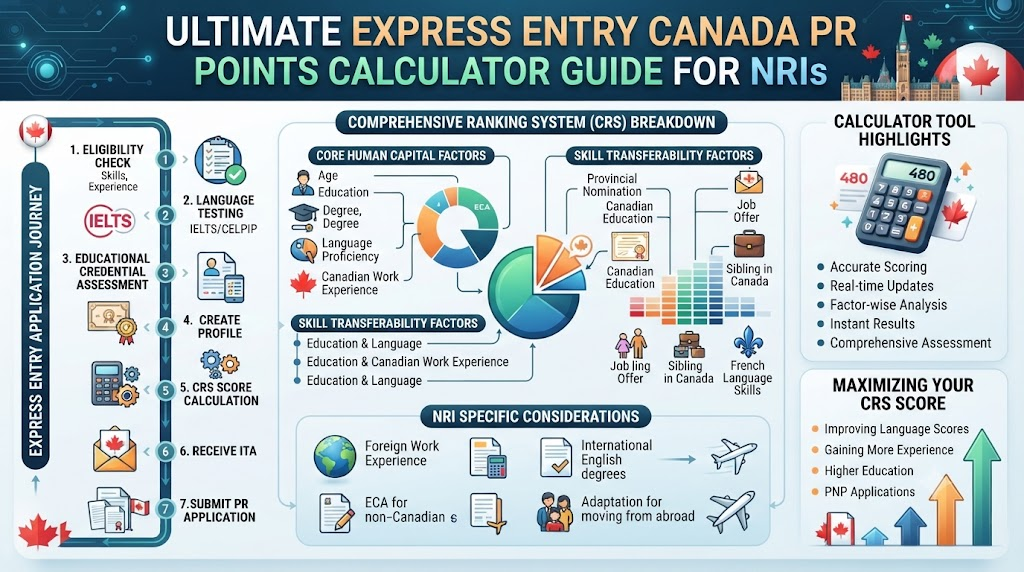
Navigating Canada’s economic immigration pathways requires a clear understanding of how applicant profiles are evaluated. For Indian professionals, foreign workers, and international students planning a permanent move, Canada’s Express Entry system uses a criteria-driven ranking framework known as the Comprehensive Ranking System (CRS). Using a Canada Express Entry PR points calculator allows candidates to evaluate their standing in the candidate pool before submitting an official profile.This comprehensive guide details how points are assigned across core factors, spouse attributes, skill transferability, and additional options. Whether you are applying independently or evaluating options alongside community insights on DesiNRI, understanding this points breakdown provides clarity on your eligibility and highlights tangible areas for optimization.
What Is the Express Entry PR Points System?
Express Entry is an online selection framework managed by Immigration, Refugees and Citizenship Canada (IRCC) to manage applications for key economic immigration streams:
- Federal Skilled Worker Program (FSWP)
- Canadian Experience Class (CEC)
- Federal Skilled Trades Program (FSTP)
The Comprehensive Ranking System (CRS) ranks candidates out of a maximum of 1,200 total points. When IRCC conducts rounds of invitations, candidates who meet or exceed the cutoff score for a specific category or general draw receive an Invitation to Apply (ITA) for Canadian permanent residence.
Who Is the PR Points Calculator For?
- Skilled Professionals in India: Individuals assessing their eligibility under foreign work experience and academic credentials.
- Indian Expatriates: Skilled workers residing outside India who want to explore direct PR options.
- International Graduates in Canada: Former students seeking to leverage Canadian study and post-graduation work experience.
- Temporary Foreign Workers: Individuals currently working in Canada on temporary work permits.
Comprehensive Ranking System (CRS) Points Breakdown
The 1,200 CRS points are distributed across four main sections:
+-------------------------------------------------------------------+
|                  MAXIMUM TOTAL POINTS: 1,200                      |
+-------------------------------------------------------------------+
| A. Core Human Capital Factors             | Max 500 points        |
| B. Spouse / Common-Law Partner Factors    | Max 40 points         |
| C. Skill Transferability Factors          | Max 100 points        |
| D. Additional Points                      | Max 600 points        |
+-------------------------------------------------------------------+
Note: The combined maximum for Core Human Capital (A) + Spouse Factors (B) is strictly capped at 500 points.
Section A: Core Human Capital Factors (Maximum 500 Points)
Core human capital evaluates an applicant’s core background details. Single applicants receive up to 500 points directly, while applicants with an accompanying spouse or partner are scored out of 460 points (with 40 points allocated to spouse factors).
1. Age (Max 110 points single / 100 with spouse)
Points for age peak between 20 and 29 years and decline progressively as an applicant gets older.
- Ages 20–29: 110 points (single) / 100 points (with spouse)
- Age 30: 105 points (single) / 95 points (with spouse)
- Age 35: 77 points (single) / 70 points (with spouse)
- Age 40: 49 points (single) / 45 points (with spouse)
- Age 45 or older: 0 points
2. Level of Education (Max 150 points single / 140 with spouse)
Educational credentials obtained outside Canada require an Educational Credential Assessment (ECA) from an approved agency like WES to claim points.
- Secondary school (High School): 30 points (single) / 28 points (with spouse)
- 1-year post-secondary program: 90 points (single) / 84 points (with spouse)
- 3-year post-secondary program or Bachelor’s degree: 120 points (single) / 112 points (with spouse)
- Two or more post-secondary credentials (one must be 3+ years): 128 points (single) / 119 points (with spouse)
- Master’s degree or professional degree: 135 points (single) / 126 points (with spouse)
- Doctoral degree (Ph.D.): 150 points (single) / 140 points (with spouse)
3. Official Language Proficiency (Max 160 points single / 150 with spouse)
Language ability is measured using Canadian Language Benchmark (CLB) levels via approved tests such as IELTS, PTE Core, or CELPIP for English, and TEF or TCF for French. Points are calculated per skill (Reading, Writing, Listening, Speaking).
- First Official Language (Max 136 points single / 128 with spouse):
- CLB 7: 17 points per ability (single) / 16 (with spouse)
- CLB 8: 23 points per ability (single) / 22 (with spouse)
- CLB 9: 31 points per ability (single) / 29 (with spouse)
- CLB 10+: 34 points per ability (single) / 32 (with spouse)
- Second Official Language (Max 24 points single / 22 with spouse):
- Points are awarded for achieving CLB 5 or higher across skills in your second language.
4. Canadian Work Experience (Max 80 points single / 70 with spouse)
Scored for full-time (or equivalent part-time) skilled work experience in Canada under TEER 0, 1, 2, or 3 categories.
- 1 year: 40 points (single) / 35 points (with spouse)
- 2 years: 53 points (single) / 46 points (with spouse)
- 3 years: 64 points (single) / 56 points (with spouse)
- 5+ years: 80 points (single) / 70 points (with spouse)
Section B: Spouse / Common-Law Partner Factors (Maximum 40 Points)
If you apply with an accompanying partner, their qualifications contribute directly to your profile:
- Spouse Level of Education: Up to 10 points (10 points for Master’s/Ph.D., 8 points for Bachelor’s).
- Spouse First Official Language: Up to 20 points (5 points per skill reaching CLB 9+).
- Spouse Canadian Work Experience: Up to 10 points (10 points for 5+ years, 5 points for 1 year).
Section C: Skill Transferability Factors (Maximum 100 Points)
This section provides combination points based on how your language skills and work experience interact with your educational qualifications. The entire section is capped at a maximum of 100 points.
Education + Language / Canadian Experience Combination (Max 50 Points)
- Good language skills (CLB 7 in all abilities) + Post-secondary degree: 13 to 25 points.
- High language skills (CLB 9 in all abilities) + Post-secondary degree: 25 to 50 points.
- 1 year of Canadian work experience + Post-secondary degree: 13 to 25 points.
- 2+ years of Canadian work experience + Post-secondary degree: 25 to 50 points.
Foreign Work Experience Combinations (Max 50 Points)
- 1–2 years foreign experience + High language skills (CLB 9+): 25 points.
- 3+ years foreign experience + High language skills (CLB 9+): 50 points.
- 1–2 years foreign experience + 1 year Canadian work experience: 25 points.
- 3+ years foreign experience + 1 year Canadian work experience: 50 points.
Section D: Additional Points (Maximum 600 Points)
Additional points offer significant opportunities to boost your CRS score:
- Provincial Nomination: 600 points (guarantees an invitation in subsequent draws).
- French Language Skills: 25 points (strong French with weak English) or 50 points (strong French combined with CLB 5 or higher in English).
- Canadian Post-Secondary Education: 15 points for 1–2 year programs; 30 points for 3+ year, Master’s, or Doctoral programs.
- Sibling in Canada: 15 points (sibling must be 18+, a permanent resident or citizen, and residing in Canada).
CRS Factors Quick Comparison Table
| Component | Maximum Points (Single) | Maximum Points (With Spouse) | Core Eligibility / Benchmark Requirements |
| Age | 110 | 100 | Points peak between ages 20–29. |
| Education Level | 150 | 140 | ECA evaluation required for foreign degrees. |
| First Official Language | 136 | 128 | Maximum score achieved at CLB 10+. |
| Canadian Work Experience | 80 | 70 | Must be skilled work (TEER 0, 1, 2, or 3). |
| Spousal Factors | N/A | 40 | Combines education, language, and Canadian work. |
| Skill Transferability | 100 | 100 | Combines education, language, and work experience. |
| Provincial Nomination (PNP) | 600 | 600 | Requires nomination from a Canadian province. |
| French Language Proficiency | 50 | 50 | Requires NCLC 7 or higher in French tests. |
| Canadian Study Experience | 30 | 30 | Post-secondary credential earned in Canada. |
| Sibling in Canada | 15 | 15 | Citizen/PR sibling aged 18+ living in Canada. |
Step-by-Step Guide to Applying for Express Entry
+-------------------------------------------------------------------+
| STEP 1: Complete ECA and Language Assessments                    |
+-------------------------------------------------------------------+
                                  │
                                  ▼
+-------------------------------------------------------------------+
| STEP 2: Calculate Your Baseline CRS Score                         |
+-------------------------------------------------------------------+
                                  │
                                  ▼
+-------------------------------------------------------------------+
| STEP 3: Submit Express Entry Profile to IRCC Pool                  |
+-------------------------------------------------------------------+
                                  │
                                  ▼
+-------------------------------------------------------------------+
| STEP 4: Monitor Draw Cutoffs and Consider PNP Options             |
+-------------------------------------------------------------------+
                                  │
                                  ▼
+-------------------------------------------------------------------+
| STEP 5: Receive Invitation to Apply (ITA)                         |
+-------------------------------------------------------------------+
                                  │
                                  ▼
+-------------------------------------------------------------------+
| STEP 6: Submit Complete PR Application within 60 Days             |
+-------------------------------------------------------------------+
- Complete Educational Credential Assessment (ECA): Obtain ECA reports from an authorized body (e.g., WES) for non-Canadian credentials.
- Take Language Ability Tests: Complete approved tests in English (IELTS/PTE) or French (TEF/TCF).
- Calculate Your Score: Sum points from Core, Spousal, Transferability, and Additional categories.
- Create an Express Entry Profile: Submit details on the official IRCC portal to enter the pool.
- Explore Provincial Nomination Options: If your base score is below recent cutoff trends, apply to Express Entry-aligned PNP streams.
- Respond to an Invitation to Apply (ITA): Upon receiving an ITA, submit a full permanent residency application within 60 days, including police clearance, medical exams, and work references.
Hypothetical Example: How Profiles Are Calculated
- Candidate Profile: An open-market applicant named Rajesh, aged 29, holds a Master’s degree from India, has 4 years of foreign IT work experience, and achieved CLB 9 across all modules in IELTS. He applies as a single applicant without Canadian study or work experience.
- Points Calculation:
- Age (29): 110 points
- Education (Master’s Degree): 135 points
- First Official Language (CLB 9): 124 points (31 x 4 skills)
- Skill Transferability (Master’s + CLB 9): 50 points
- Skill Transferability (3+ Yrs Foreign Experience + CLB 9): 50 points
- Additional Points: 0 points
- Total Baseline CRS Score: 469 points
If Rajesh improves his language assessment to CLB 10 or adds intermediate French language proficiency, his total score will increase, strengthening his standing for standard or category-based invitation rounds.
Common PR Points Mistakes to Avoid
- Relying on Unverified Online Calculators: Always reference official IRCC scoring rules or cross-check output with official guidelines.
- Inaccurate Language Assessment Mapping: Ensure your test scores correspond directly to the correct CLB equivalency tiers rather than raw band scores.
- Misclassifying Foreign Work Experience: Work experience must fall under NOC TEER 0, 1, 2, or 3 categories and be backed by employment reference letters.
- Assuming Non-Accredited Degrees Qualify: Foreign education must be evaluated by a recognized ECA provider to claim CRS points.
- Overlooking Provincial Nomination Streams: Candidates under overall draw cutoffs often miss out by failing to register for aligned PNP pathways.
Practical Tips for Applicants
- Maximize Language Test Scores: Achieving CLB 9 or higher (8 in Listening, 7 in Reading, Writing, Speaking for IELTS) significantly increases both language and transferability points.
- Evaluate Secondary Language Options: Learning French to NCLC 7 level unlocks up to 50 additional CRS points and opens category-specific draws.
- Ensure ECA Validity: Verify that your Educational Credential Assessment remains valid (less than five years old at profile submission).
- Maintain Accurate Documents: Gather official employment reference letters detailing job duties, hours, and pay rates early in the process.
- Leverage Expat Community Knowledge: Engage with experienced candidates on platforms like DesiNRI to discuss application tracking, document collection strategies, and recent invitation trends.
10 FAQs
1. What is an Express Entry PR points calculator?
An Express Entry PR points calculator is a system based on IRCC criteria designed to estimate an applicant’s Comprehensive Ranking System (CRS) score. It measures factors like age, education, language skills, and work experience to determine rank within the candidate pool.
2. What is a passing CRS score for Express Entry?
There is no fixed passing score in Express Entry. Cutoff thresholds fluctuate with every invitation round based on immigration targets, draw types (general vs. category-based), and the distribution of scores in the pool.
3. Can I apply for Express Entry without a job offer?
Yes. A job offer is not mandatory for Express Entry pathways like the Federal Skilled Worker Program or Canadian Experience Class. Candidates qualify based on human capital factors like age, language ability, education, and work experience.
4. How does learning French affect my Canada PR points?
Achieving proficiency in French (NCLC 7 or higher) can add up to 50 additional CRS points when combined with English skills. It also opens up targeted French-language category draws that historically feature lower CRS cutoffs.
5. Does age lower my CRS score?
Yes. Maximum age points (110 for single applicants) are awarded between ages 20 and 29. Starting at age 30, point allocations gradually decline each year, reaching zero points at age 45.
6. What is an Educational Credential Assessment (ECA)?
An ECA is an independent verification process conducted by designated bodies (such as WES) to confirm that a degree, diploma, or certificate earned outside Canada is valid and equivalent to a Canadian credential.
7. How many points does a Provincial Nomination (PNP) add?
A valid nomination under an Express Entry-aligned Provincial Nominee Program adds 600 points to your CRS profile. This effectively guarantees an Invitation to Apply in subsequent Express Entry draws.
8. Can I add points for my spouse’s credentials?
Yes. If your spouse is accompanying you to Canada, their educational level, official language scores, and Canadian work experience can contribute up to 40 points toward your total score.
9. How long are language test results valid for Express Entry?
Language test results (IELTS, PTE Core, CELPIP, TEF, TCF) are valid for exactly two years from the test date and must remain valid when submitting your profile and PR application.
10. Where can I find community support for Canada immigration?
Expatriates, international students, and applicants can connect on community platforms such as DesiNRI to share relocation experiences, clear up practical questions, and discuss Express Entry updates.
Conclusion
Understanding how Canada’s Express Entry PR points calculator scores your background is an important step in planning your immigration journey. By evaluating factors like education, language proficiency, and work experience, candidates can identify practical steps to optimize their profiles. While securing high language scores and completing credential assessments form the core foundation of an application, exploring additional pathways like Provincial Nominee Programs or learning French can provide strategic point increases.Because immigration guidelines and round cutoffs change over time, applicants should always verify official criteria on the government IRCC website before submitting documentation. For community support, shared applicant experiences, and expatriate resources, platforms like DesiNRI offer helpful spaces to connect with fellow applicants throughout the relocation journey.