Introduction
How do modern defense organizations synchronize activities across land, sea, air, space, and cyberspace into a unified strategic approach? This fundamental question lies at the center of multidomain operations, a conceptual framework that has transformed modern defense studies and strategic planning. As defense technology advances and operational environments become increasingly complex, understanding how separate operational domains interact is essential for students, researchers, and policy analysts. Educational platforms like WarOpsX examine these systems by breaking down the relationships between command structures, logistics, information flows, and organizational readiness.
Understanding the Core Concept of Multidomain Operations
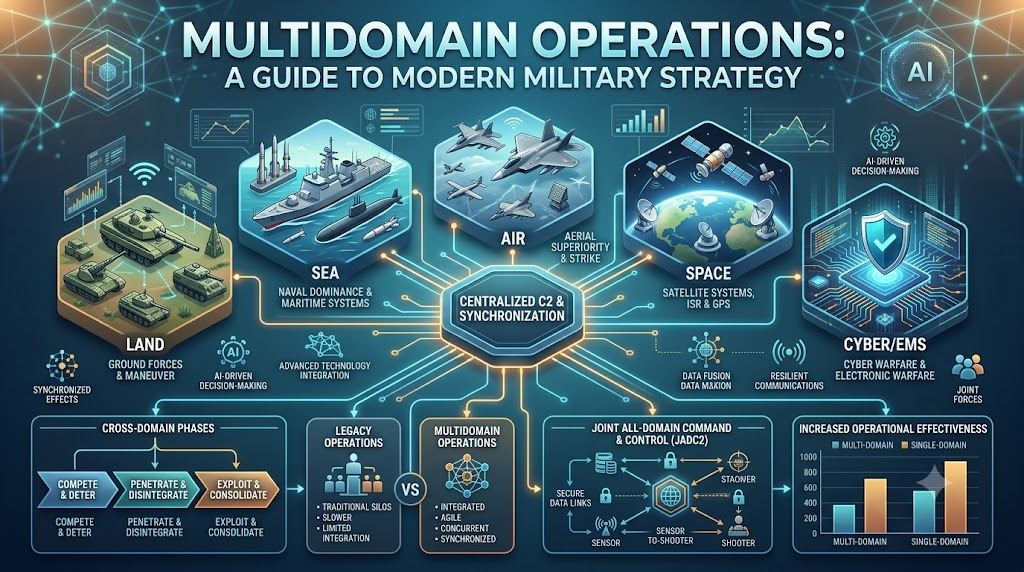
Multidomain operations refer to the conceptual and organizational framework used to coordinate activities across five primary domains: land, maritime, air, space, and cyberspace (which includes the broader information environment). In traditional military history, defense forces primarily operated within distinct physical environments, organizing separate services for army, naval, and air forces. While twentieth-century doctrines introduced joint operations to coordinate these services, modern defense studies emphasize that domain interactions are no longer purely physical or sequential.
The primary objective of a multidomain approach is to create synchronized operational effects across multiple domains simultaneously or in rapid succession. Rather than treating space or cyberspace as secondary support functions for ground troops, multidomain theory views all five areas as interconnected arenas of competition and coordination. Achieving this requires organizational flexibility, rapid information sharing, and robust command and control systems that prevent isolated decision-making within individual operational branches.
Military Strategy and Command and Control Systems
Strategic Alignment Across Operational Domains
In the study of military strategy, aligning high-level policy goals with operational capabilities requires continuous risk assessment and resource allocation. Multidomain strategy operates at the intersection of national security objectives, organizational readiness, and technological capability. Strategy differs fundamentally from tactics: while tactics concern specific field movements and localized actions, strategy addresses the broader alignment of ends, ways, and means over time.
In a multidomain environment, strategic leaders must balance resources across disparate domain needs. Allocating capital to space-based sensor platforms or cyber defense infrastructure requires tradeoffs with traditional ground armored systems or naval surface fleets. Strategic adaptation relies on understanding how capabilities in one domain compensate for vulnerabilities in another, ensuring that organizational goals remain achievable even when specific channels face disruption.
Evolution of Command and Control Architecture
Command and control systems form the operational nervous system of any military organizational structure. Historically, command structures relied on strict top-down hierarchies with manual communication channels, which created delays when relaying information between ground forces, naval vessels, and air squadrons. As defense technology evolved, command structures transitioned toward networked architectures capable of processing digital data streams in near-real-time.
Modern command systems in multidomain operations require high levels of interoperability—the technical and procedural ability of different military branches and allied organizations to share data seamlessly. Decision-makers require shared situational awareness, where radar feeds, satellite imagery, cyber telemetry, and ground observations merge into a single operational picture. The central challenge for command leadership is avoiding information overload, ensuring commanders receive prioritized, actionable analysis rather than overwhelming raw data.
Defense Technology and ISR Integration
The Role of Intelligence, Surveillance, and Reconnaissance (ISR)
Intelligence, Surveillance and Reconnaissance (ISR) serves as the foundation for decision-making in multidomain contexts. While these three terms are often grouped together, defense studies distinguish their specific functions:
- Intelligence: The product resulting from the processing, integration, analysis, and interpretation of available information regarding operational environments or foreign capabilities.
- Surveillance: The systematic, continuous observation of aerospace, surface, subsurface, or cyber spaces to collect data.
- Reconnaissance: Focused, time-sensitive missions undertaken to obtain specific information about environmental or organizational conditions.
In multidomain operations, ISR assets collect data simultaneously across all domains. Space-based optical sensors provide geographic coverage, maritime sonar arrays monitor underwater acoustic signatures, and cyber monitoring tools inspect network telemetry. Integrating these varied inputs allows defense organizations to detect emerging patterns earlier than single-domain observation methods permit.
Emerging Defense Technologies in Multidomain Frameworks
Modern defense technology increasingly relies on data processing architectures, automated analytics, and advanced communication networks to link isolated hardware platforms. Key technological areas include:
- Data Fusion Platforms: Software algorithms that combine inputs from disparate sensors to create clear operational maps.
- Autonomous Systems: Unmanned aerial, surface, and ground platforms used for routine monitoring, environmental sensing, or supply transport.
- Space Capabilities: Satellite networks providing global positioning, communications, and atmospheric observation.
- Cyber Defenses: Protocols designed to safeguard critical networks, data integrity, and communication channels.
While these technologies enhance situational awareness, they introduce limitations. Complex digital systems increase vulnerability to technical outages, hardware failures, and network disruptions. Effective organizational planning requires maintaining manual fallbacks and resilient operational procedures when technological links fail.
Military Logistics and Organizational Structure
Logistics and Sustainment in Multidomain Environments
Military logistics encompasses the planning, transportation, maintenance, and sustainment of personnel and material resources. In single-domain operations, logistics focuses primarily on supply lines, fuel distribution, ammunition storage, and equipment repair. Multidomain operations expand this challenge by requiring logistical synchronization across physical transport routes and digital infrastructure simultaneously.
Logistical resilience depends on maintaining flexible supply chains capable of adapting to unexpected disruptions. Transporting fuel or spare parts to ground or maritime formations requires secure air routes, reliable sea lines of communication, and protected digital inventory databases. If a cyber network managing spare parts tracking is compromised, physical repair schedules stall regardless of material availability. Consequently, modern military logistics treats digital network security as an essential component of physical readiness.
Organizational Hierarchy and Interoperability
To execute multidomain concepts, military organizational structures have evolved from isolated service branches toward integrated joint forces and functional commands. A standard organizational hierarchy structures units by operational scope:
- Strategic Level: High-level headquarters establishing national policy, long-term resource allocation, and alliance coordination.
- Operational Level: Joint command headquarters directing regional campaigns and integrating air, land, maritime, space, and cyber resources.
- Tactical Level: Specialized units executing specific tasks within defined geographic or functional boundaries.
Interoperability across these levels requires standardized communication protocols, shared training standards, and joint doctrine. Establishing functional headquarters dedicated specifically to space or cyber operations allows defense organizations to manage specialized technical assets while maintaining clear lines of communication with traditional land, air, and sea commanders.
Ethics, Civil-Military Relations, and Governance
The expanding reach of multidomain operations highlights the importance of ethical governance and international law. As operations encompass space assets and digital networks, defense planners must account for civil-military boundaries, civilian infrastructure protection, and humanitarian obligations. Space and cyber networks frequently host both military and civilian data; disruptions in these domains carry significant risks for civilian communications, power grids, and economic activity.
Maintaining strict human oversight over decision-support systems and respecting established international legal frameworks ensures that defense organizations operate within ethical boundaries. Policy researchers emphasize that technological capability must remain subordinate to political accountability and civilian governance.
Comparison of Operational Domains
| Domain | Primary Focus | Key Capabilities & Assets | Primary Operational Challenge | Integration Function |
| Land | Physical terrain and populations | Infantry, mechanized units, ground artillery | Terrain constraints, heavy logistical footprint | Secures geographic ground, interacts with civil populations |
| Maritime | Oceans, seas, and sea lines | Surface vessels, submarines, naval aviation | Vast operational areas, deep-water communications | Protects trade routes, enables amphibious transport |
| Air | Atmosphere and airspace | Aircraft, aerial refueling, air defense systems | Weather sensitivity, high fuel consumption | Provides rapid mobility, wide observation, aerial transport |
| Space | Extra-atmospheric orbit | Satellites, orbital sensors, positioning systems | High launch costs, orbital mechanics constraints | Enables global communications, GPS, strategic ISR |
| Cyber | Digital networks and data | Server infrastructure, networks, encryption software | Rapid technological change, attribution difficulties | Links all domain C2 systems, protects data integrity |
Historical and Hypothetical Examples
Historical Example 1: WWII Combined Operations (Operation Overlord, 1944)
While predating the formal definition of multidomain operations, the Allied invasion of Normandy represented an early milestone in cross-domain synchronization. Planners had to coordinate land forces, naval transport, and air support alongside early electronic deception efforts. The success of the landing depended on integrating these distinct domains rather than allowing each service branch to operate independently.
Historical Example 2: The Integration of Satellite Navigation (1990s)
The early 1990s marked a major technological shift as satellite-based positioning systems transitioned from experimental technology to core defense infrastructure. Integrating orbital capabilities with ground transport, naval navigation, and air strike coordination demonstrated how space systems could enhance physical operations across all traditional domains.
Hypothetical Example 3: Regional Logistical Supply Scenario
Consider a hypothetical defense organization managing supply distribution during a humanitarian response mission in an island nation. Heavy storms degrade air transport channels, while localized cyber outages disrupt electronic supply databases. A multidomain approach allows planners to reroute supplies via maritime surface vessels using satellite tracking data while restoring network integrity through redundant communication channels, maintaining support despite individual domain failures.
Strategic Analysis Framework
- Define the Strategic Objective: Identify the primary policy goal, desired end-state, and high-level directives.
- Identify Organizations and Actors: Map the military branches, allied forces, civil agencies, and international partners involved.
- Examine Resources and Constraints: Assess available personnel, equipment, industrial capacity, geography, and budget limitations.
- Analyze Information Requirements: Identify key ISR inputs, communication pathways, and data verification steps needed for decision-making.
- Evaluate Logistics and Readiness: Determine supply chain routes, maintenance protocols, transport capacity, and sustainment reserves.
- Assess Technology and Interoperability: Review network compatibility, sensor data fusion, hardware limitations, and backup systems.
- Evaluate Risks and Uncertainty: Identify single points of failure, cyber vulnerabilities, weather hazards, and potential escalation risks.
- Review Policy and Legal Context: Ensure alignment with national laws, international conventions, and civil-military accountability standards.
Common Misconceptions
- Multidomain operations are just a new name for joint operations: Traditional joint operations focus on coordinating army, navy, and air forces. Multidomain operations incorporate non-physical domains like space and cyberspace as equal operating environments from the outset.
- Technology solves all operational challenges: Advanced software and automation improve data flow, but they do not eliminate operational friction, human error, or physical logistics constraints.
- More data automatically results in better decisions: Large volumes of raw sensor data often cause information overload. Effective command depends on data processing, clear prioritization, and analytical clarity.
- Logistics is limited to physical transportation: Modern logistics depends heavily on secure digital networks, software tracking systems, and cyber defense to maintain supply chain visibility.
- Strategy and tactics are interchangeable: Strategy establishes long-term goals and resource alignment, whereas tactics focus on localized execution and short-term movements.
Frequently Asked Questions
1. What are Multidomain Operations?
Multidomain operations refer to the strategic and operational framework that synchronizes activities across land, maritime, air, space, and cyber environments. The approach ensures defense organizations operate cohesively across all operational domains simultaneously rather than managing each branch independently.
2. How do multidomain operations differ from joint operations?
Joint operations focus primarily on coordinating traditional military branches such as the army, navy, and air force. Multidomain operations expand this concept by fully integrating space, cyberspace, and the information environment as core operational arenas alongside traditional physical domains.
3. What is the role of Intelligence, Surveillance, and Reconnaissance (ISR)?
ISR provides situational awareness by gathering, analyzing, and distributing information from multiple domains. It combines satellite data, aerial observation, naval sonar, and network monitoring to help leaders make informed strategic and operational decisions.
4. Why is interoperability important in multidomain operations?
Interoperability allows different service branches, technologies, and international allies to share data and communicate seamlessly. Without standardized equipment protocols and joint procedures, data remains isolated within individual service branches, slowing decision-making.
5. How does defense technology support multidomain integration?
Defense technology provides data fusion software, communication networks, satellite infrastructure, and sensor systems. These tools combine information from multiple domains into unified displays, giving commanders clear visibility across complex operational environments.
6. What are the primary logistics challenges in multidomain operations?
Logistics challenges include managing complex global supply chains, protecting inventory databases from network disruptions, and coordinating physical transport across air, sea, and land routes during unexpected environmental or technical disruptions.
7. How do space capabilities contribute to defense studies?
Space capabilities provide global communications, position tracking, weather monitoring, and early warning ISR data. Defense studies analyze space assets as critical infrastructure that supports ground, maritime, and air operations.
8. What is the difference between strategy and tactics in defense analysis?
Strategy focuses on long-term policy objectives, high-level resource allocation, and organizational planning. Tactics involve localized movements, specific tasks, and immediate actions executed by operational units in the field.
9. How do cyber capabilities fit into multidomain strategy?
Cyber capabilities protect critical digital networks, safeguard communication databases, and ensure data integrity across command structures. They secure the digital infrastructure that connects physical platforms across land, sea, air, and space.
10. Where can students find resources to study defense systems?
Students and researchers can study open-access academic journals, policy publications, institutional defense studies, and educational platforms like WarOpsX to build foundational knowledge about military strategy, history, and organizational systems.
Conclusion
Understanding multidomain operations is vital for analyzing modern defense environments. By examining how land, maritime, air, space, and cyber domains interact, researchers and policy analysts gain valuable insights into the complexities of contemporary military strategy. Success in this field relies not merely on hardware, but on the effective integration of command and control systems, logistics resilience, intelligence processing, and clear organizational structures. As technology continues to evolve, educational platforms like WarOpsX provide structured, non-operational learning resources that help students, academics, and defense enthusiasts explore these essential strategic concepts from a grounded, analytical perspective.