Your heart works tirelessly every single day, pumping life-sustaining blood throughout your body. At the center of this incredible biological engine are four delicate heart valves that act like precise unidirectional doorways, ensuring blood flows in the right direction. When one of these valves becomes diseased, damaged, or fails to close properly, it can affect your entire cardiovascular system. At Best Cardiac Hospitals, we believe that well-informed patients and families are better equipped to navigate complex cardiovascular healthcare choices. This comprehensive educational guide explores heart valve disease, surgical procedures, advanced technologies, hospital selection criteria, and what to expect during recovery.
What Is Heart Valve Repair?
Heart valve repair is a specialized cardiac surgical or catheter-based procedure designed to fix a malfunctioning heart valve so it can open fully and close tightly.To understand why repair is so beneficial, it helps to look at the difference between repair and replacement:
- Valve Repair: The patient’s native valve is reshaped, reinforced, or reconstructed using specialized surgical techniques. This preserves the heart’s natural geometry and often eliminates the need for long-term blood-thinning medications.
- Valve Replacement: The damaged valve is removed entirely and substituted with an artificial mechanical or biological tissue valve.
Heart valves regulate blood flow by opening and closing in coordination with heart muscle contractions. When they fail, two main disorders occur:
- Valve Regurgitation (Leaking): The valve leaflets do not close tightly, allowing blood to leak backward.
- Valve Stenosis (Narrowing): The valve opening becomes stiff or narrowed, restricting forward blood flow.
Individualized treatment planning is critical. Repair is commonly performed for mitral valve disease, selected tricuspid valve disorders, and certain aortic valve conditions when anatomically suitable.
Types of Heart Valve Disorders
Heart valve disease can be congenital (present at birth) or acquired over time due to aging, infections, calcium buildup, or previous medical conditions.
Mitral Valve Regurgitation
Occurs when the mitral valve leaflets fail to seal properly, causing blood to flow backward into the left atrium during heart contraction.
Mitral Valve Prolapse
A common condition where the mitral valve leaflets stretch or bulge into the upper heart chamber during a heartbeat, sometimes leading to mild or moderate leaking.
Aortic Valve Regurgitation
Involves backward leakage through the aortic valve, forcing the heart to work harder to pump blood out to the rest of the body.
Tricuspid Valve Regurgitation
Happens when the tricuspid valve between the right atrium and right ventricle does not close completely, often secondary to other heart conditions.
Congenital Valve Disorders
Structural abnormalities present from birth, such as bicuspid aortic valves (having two leaflets instead of the normal three).
Infective Endocarditis (Selected Cases)
An infection of the heart’s inner lining and valves that can damage valve tissue, requiring careful medical and sometimes surgical intervention.
Types of Heart Valve Repair Procedures
Cardiac surgeons utilize a variety of sophisticated techniques tailored to the specific valve involved and the underlying mechanism of failure.
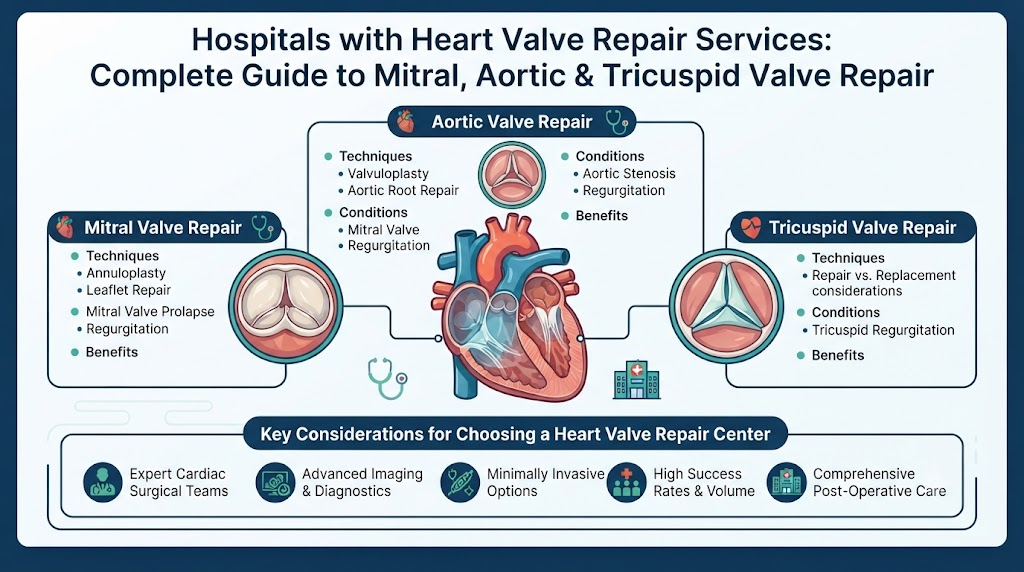
Mitral Valve Repair
- Annuloplasty: Sewing a supportive ring around the outside of the valve opening to tighten loose tissue and help leaflets meet properly.
- Leaflet Repair: Trimming, reshaping, or patching damaged valve tissue to restore a tight seal.
- Chordal Repair or Replacement: Reconstructing or replacing tiny fibrous cords (chorda tendineae) that anchor the valve leaflets using artificial Gore-Tex sutures.
- Commissurotomy: Opening fused valve flaps to relieve narrowing in stenotic valves.
Aortic Valve Repair
Surgical reshaping, cusp reconstruction, or reimplantation techniques designed to preserve the native aortic valve, particularly in younger patients with aortic root dilation.
Tricuspid Valve Repair
Usually performed via annuloplasty rings or tissue reshaping to correct right-sided heart valve leakage, often during other cardiac procedures.
Catheter-Based Edge-to-Edge Repair (Selected Patients)
A minimally invasive procedure where a small clip is guided through a blood vessel to clasp leaking mitral valve leaflets together, reducing regurgitation without open surgery.
The repair technique depends on the valve involved, the cause of disease, and surgical assessment.
Heart Valve Repair Services Comparison Table
| Service | Primary Purpose | Benefit |
|---|---|---|
| Cardiology Consultation | Diagnose valve disease | Personalized treatment planning |
| Echocardiography | Assess valve function | Accurate diagnosis |
| Heart Valve Repair Surgery | Restore valve function | Preserve native valve when appropriate |
| Minimally Invasive Valve Surgery | Smaller surgical access | Potentially faster recovery for selected patients |
| Catheter-Based Valve Repair | Less invasive treatment | Option for selected high-risk patients |
| Long-Term Cardiac Follow-Up | Monitor heart function | Ongoing cardiovascular care |
Services Offered by Leading Hospitals
Specialized cardiac centers provide an integrated spectrum of diagnostic, surgical, and rehabilitative services.
- Comprehensive Cardiology Consultation: Initial expert evaluation of symptoms, medical history, and diagnostic imaging.
- Structural Heart Disease Clinic: Dedicated multidisciplinary programs focusing exclusively on complex valve disorders.
- Advanced Echocardiography: High-resolution ultrasound imaging to visualize heart structures in real-time.
- Transesophageal Echocardiography (TEE): Specialized ultrasound performed via the esophagus for crystal-clear images of heart valves.
- Cardiac CT & MRI: Advanced cross-sectional imaging to map heart anatomy and measure cardiac function precisely.
- Minimally Invasive Heart Valve Surgery: Procedures performed through small chest incisions rather than full breastbone splitting.
- Open Heart Valve Repair: Traditional surgical approaches required for complex or multi-valve reconstructions.
- Catheter-Based Valve Repair: Advanced percutaneous treatments for patients who may not tolerate traditional surgery.
- Intensive Cardiac Care: Specialized postoperative units staffed by expert cardiovascular nurses and intensivists.
- Cardiac Rehabilitation: Structured exercise and education programs designed to rebuild strength.
- Long-Term Follow-Up: Ongoing monitoring to ensure lasting valve health and stable heart function.
Advanced Technologies Used in Modern Cardiac Care
Cutting-edge technology empowers surgical teams to perform delicate repairs with unprecedented accuracy.
- 3D Echocardiography: Generates three-dimensional moving models of heart valves to help surgeons plan repairs down to the millimeter.
- Transesophageal Echocardiography (TEE): Used intraoperatively to guide surgeons and verify repair success before the operation concludes.
- Cardiac CT: Provides detailed 3D renderings of blood vessels, coronary arteries, and valve calcium deposits.
- Cardiac MRI: Evaluates heart muscle viability, blood flow dynamics, and chamber volumes without radiation.
- Hybrid Operating Rooms: State-of-the-art surgical suites equipped with advanced imaging systems for both open and catheter-based procedures.
- Minimally Invasive Surgical Systems: Specialized long-shafted instruments and thoracoscopic cameras designed for small-incision access.
- Robotic-Assisted Cardiac Surgery: Console-guided robotic arms offering supreme dexterity for delicate mitral valve reconstructions.
- Catheter-Based Structural Technologies: Delivery systems enabling repair devices to be threaded through blood vessels from the leg.
How to Choose the Right Hospital for Heart Valve Repair
Selecting the appropriate medical center is one of the most critical decisions in your cardiac care journey. Repair may not be appropriate for every patient, and treatment decisions depend on individual valve anatomy and disease severity.
Key features to evaluate when researching hospitals include:
- Experienced Cardiac Surgeons: High-volume surgeons with specific fellowship training and expertise in valve reconstruction.
- Dedicated Structural Heart Program: Specialized clinics focused on advanced valvular interventions.
- Advanced Cardiac Imaging: Comprehensive diagnostic suites capable of precise pre-procedural mapping.
- Multidisciplinary Heart Team: Collaborative groups of cardiologists, cardiac surgeons, imagers, and anesthesiologists reviewing cases together.
- High-Quality Intensive Care Support: Specialized cardiac ICUs with dedicated cardiovascular nursing staff.
- Cardiac Rehabilitation Services: On-site or affiliated programs to guide safe physical recovery.
- Long-Term Follow-Up Programs: Structured surveillance schedules to monitor valve performance over years.
Hospital Selection Checklist
| Feature | Why It Matters |
|---|---|
| Experienced Cardiac Surgeons | Specialized valve repair expertise improves likelihood of successful native valve preservation |
| Advanced Cardiac Imaging | Accurate diagnosis and surgical planning |
| Structural Heart Program | Comprehensive, coordinated valve care under one roof |
| Hybrid Operating Rooms | Advanced treatment options combining surgery and catheter techniques |
| Cardiac ICU | Specialized postoperative care during the critical recovery phase |
| Cardiac Rehabilitation | Supports safe physical and emotional recovery after surgery |
Diagnostic Tests Before Heart Valve Repair
Before recommending a specific treatment plan, cardiac teams perform thorough diagnostic evaluations.
- Medical History: Detailed review of symptoms, past illnesses, family history, and lifestyle factors.
- Physical Examination: Listening closely for heart murmurs, checking blood pressure, and assessing fluid retention signs.
- Echocardiography: Non-invasive ultrasound to visualize valve structure, leaking severity, and heart chamber size.
- Electrocardiogram (ECG): Recording the heart’s electrical activity to check for rhythm abnormalities like atrial fibrillation.
- Cardiac CT: Detailed anatomical imaging to evaluate coronary arteries and valve calcification.
- Cardiac MRI: Precise assessment of heart muscle function and blood flow volumes.
- Cardiac Catheterization: Invasive imaging used selectively to check coronary artery blockages and measure heart pressures.
- Blood Tests: Comprehensive laboratory work assessing kidney function, blood counts, and clotting profiles.
What to Expect During Heart Valve Repair
Knowing what happens on the day of your procedure helps reduce anxiety for patients and their families.
- Preoperative Preparation: Reviewing anesthesia guidelines, starting intravenous lines, and positioning monitoring equipment.
- Anesthesia: Administration of general anesthesia so you remain completely asleep and pain-free throughout the procedure.
- Surgical or Catheter-Based Repair: The cardiac team performs the planned repair—either through a small incision, standard sternotomy, or percutaneous catheter route.
- Intraoperative Imaging: TEE imaging confirms that the valve is functioning correctly before the procedure ends.
- Intensive Care Monitoring: Transfer to the cardiac ICU for close monitoring of vital signs, heart rhythm, and breathing.
- Hospital Stay: Gradual transition from the ICU to a step-down unit as recovery progresses, typically lasting several days.
- Early Mobilization: Walking short distances with nursing support to encourage circulation and prevent stiffness.
- Follow-up Care: Discharge instructions, medication schedules, and outpatient rehabilitation planning.
Recovery After Heart Valve Repair
Recovery varies depending on the procedure performed, the patient’s health, and whether minimally invasive or open surgery was used. (Brigham and Women’s Hospital)
- Hospital Recovery: Focuses on pain management, breathing exercises, and regaining mobility.
- Pain Management: Controlled with prescribed medications that taper off as healing progresses.
- Activity Restrictions: Avoiding heavy lifting, driving, and strenuous exercise for several weeks.
- Cardiac Rehabilitation: Participating in monitored exercise sessions and lifestyle counseling.
- Follow-up Echocardiograms: Scheduled imaging to verify that the repaired valve continues to function properly.
- Medication Management: Taking prescribed heart medications or temporary blood thinners if indicated.
- Lifestyle Modifications: Adopting heart-healthy eating habits, quitting smoking, and managing blood pressure.
Possible Risks and Complications
While modern heart valve repair is remarkably safe, all cardiovascular procedures carry inherent risks. Experienced cardiac teams use comprehensive safety protocols to reduce these risks.
- Bleeding: Postoperative bleeding requiring monitoring or rare intervention.
- Infection: Surgical site or internal infections managed with antibiotics or specialized care.
- Heart Rhythm Disturbances: Temporary arrhythmias like atrial fibrillation, which are common after cardiac surgery and treatable with medication.
- Blood Clots: Prevented through early mobility and appropriate use of blood thinners when prescribed.
- Residual Valve Leakage: Minor or significant leaking that may require ongoing monitoring or future adjustment.
- Need for Future Intervention: The possibility that a repaired valve may require additional treatment years down the road.
- Stroke: A rare but serious neurological complication minimized by meticulous surgical techniques.
- Procedure-specific complications: Unique risks related to patient age, underlying health, and anatomy.
How BESTCARDIACHOSPITALS Helps Patients
Navigating cardiovascular health information can feel complex. BESTCARDIACHOSPITALS serves as a trusted educational platform designed to empower patients:
- Cardiac Hospital Discovery: Helping families understand what to look for in advanced cardiac care centers.
- Heart Valve Disease Education: Breaking down intricate medical conditions into clear, understandable explanations.
- Cardiac Surgery Information: Providing structured guides on repair techniques and technologies.
- Hospital Comparison: Offering objective criteria to evaluate specialized cardiac programs.
- Patient Guidance Resources: Equipping caregivers with practical checklists and preparation tips.
- Informed Decision-Making: Supporting patients in asking the right questions during cardiology consultations.
Common Mistakes People Make
Being proactive about heart health requires avoiding common pitfalls that can delay timely care:
- Ignoring Symptoms: Dismissing shortness of breath, fatigue, or chest discomfort as normal aging.
- Delaying Cardiology Evaluation: Waiting until heart failure develops before seeking specialist care.
- Missing Follow-up Appointments: Skipping routine echocardiograms because you feel fine.
- Stopping Medications Without Medical Advice: Discontinuing heart medications abruptly.
- Assuming Repair Is Always Possible: Believing every valve can be repaired regardless of disease severity.
- Ignoring Cardiac Rehabilitation: Skipping structured recovery programs after surgery.
Common Myths vs Facts
| Myth | Fact |
|---|---|
| Every damaged valve must be replaced | Many patients may be candidates for valve repair depending on the condition and valve anatomy |
| Valve repair is identical for every patient | Treatment is highly individualized based on the specific valve involved, disease cause, and patient anatomy |
| Minimally invasive surgery is suitable for everyone | Eligibility depends strictly on the patient’s condition, vascular access, and comprehensive surgical evaluation |
| Recovery ends after hospital discharge | Long-term follow-up and heart-healthy habits remain essential for lifelong cardiovascular wellness |
Real-Life Educational Scenarios
To see how these concepts apply in real life, consider these educational examples:
Scenario 1: Mitral Valve Prolapse Repair
A patient experiences mild fatigue and is diagnosed with mitral valve prolapse and severe regurgitation. Following evaluation at a specialized center, they undergo a successful robotic-assisted mitral valve repair. Their native valve is successfully reconstructed, preserving natural heart function and avoiding artificial valve replacements.
Scenario 2: Minimally Invasive Valve Surgery
An active adult is diagnosed with aortic valve disease. After comprehensive imaging, their heart team determines they are a candidate for minimally invasive valve surgery through a small chest incision. The procedure goes smoothly, resulting in reduced postoperative discomfort and a faster return to daily life.
Scenario 3: Catheter-Based Repair for High-Risk Patients
An elderly patient with significant heart disease develops severe mitral regurgitation but carries a high surgical risk for open-heart procedures. A multidisciplinary heart team evaluates them and successfully performs a catheter-based edge-to-edge repair, significantly reducing symptoms without major surgery.
Scenario 4: Cardiac Rehabilitation Recovery
Following a successful heart valve repair procedure, a patient enrolls in a structured cardiac rehabilitation program. With supervised exercise sessions and nutritional guidance, they safely rebuild their cardiovascular endurance and return to active living.
Frequently Asked Questions
1. What is heart valve repair?
Heart valve repair is a procedure that corrects structural defects in a damaged heart valve, allowing it to open and close properly while keeping the patient’s natural tissue intact.
2. How is valve repair different from valve replacement?
Valve repair reconstructs your own native valve, whereas valve replacement removes the damaged valve entirely and substitutes it with an artificial mechanical or tissue device.
3. Which heart valves can be repaired?
The mitral valve is the most frequently repaired valve, but tricuspid and selected aortic valve conditions can also be successfully repaired by experienced surgical teams.
4. What conditions require valve repair?
Common conditions include valve regurgitation (leaking), valve stenosis (narrowing), mitral valve prolapse, and congenital structural abnormalities.
5. Who is a candidate for minimally invasive valve surgery?
Candidates are determined through specialized imaging and surgical evaluation, taking into account the specific valve involved, overall health, and anatomical features.
6. What tests are required before surgery?
Preoperative tests typically include echocardiograms (transthoracic and transesophageal), electrocardiograms, cardiac CT or MRI, blood work, and sometimes cardiac catheterization.
7. How long does heart valve repair surgery take?
Most open or minimally invasive heart valve repair procedures take between three to six hours, depending on complexity and whether other cardiac work is needed.
8. How long is the hospital stay?
Hospital stays generally range from three to seven days, depending on the type of procedure performed and individual recovery progress.
9. What is cardiac rehabilitation?
Cardiac rehabilitation is a medically supervised program combining physical exercise, education, and counseling designed to help patients recover safely and strengthen their hearts.
10. What are the risks of valve repair?
Risks include bleeding, infection, temporary heart rhythm irregularities, blood clots, and rare complications like stroke, which teams work diligently to minimize.
11. How long does recovery usually take?
Full physical recovery varies from several weeks to a few months, depending on whether minimally invasive or open surgical techniques were utilized.
12. How do I choose the right hospital?
Look for experienced cardiac surgeons, dedicated structural heart programs, advanced imaging suites, multidisciplinary heart teams, and robust postoperative care.
13. Can repaired valves last for many years?
Yes, successful surgical valve repairs can last for many decades, often outlasting biological tissue replacements and avoiding long-term blood thinners.
14. What lifestyle changes support heart health after repair?
Eating a balanced diet, exercising regularly as advised, managing stress, quitting smoking, and keeping blood pressure under control are vital.
15. How does BESTCARDIACHOSPITALS help patients find hospitals with heart valve repair services?
It provides reliable educational resources, hospital selection guidance, comparison checklists, and clear information to help families navigate cardiovascular healthcare decisions.
Final Thoughts
Early diagnosis and timely intervention are vital when managing heart valve disease. Whenever feasible, preserving your natural valve through advanced surgical repair offers exceptional long-term benefits for heart function and quality of life. Choosing an experienced cardiac surgery team equipped with modern technology ensures the highest standard of personalized care.We encourage you to explore BESTCARDIACHOSPITALS for trusted information about heart valve repair services, structural heart disease, cardiac surgery, and patient education. Always consult qualified cardiologists and cardiac surgeons to receive professional medical evaluations and treatment recommendations tailored specifically to your unique cardiovascular health needs.