Introduction
IT teams are finding new ways to manage infrastructure with less manual effort. Automation can handle routine tasks such as software deployment, resource provisioning, system checks, and common incident responses. This approach is often discussed under the term NoOps. It does not mean that technical operations disappear. Instead, it changes how people build, monitor, secure, and improve technology systems. Professionals who understand automation can help organisations create more consistent and reliable services. Learning about NoOps also gives IT workers a way to develop practical cloud and infrastructure skills. NoOpsSchool focuses on NoOps education, certification learning, and related professional services. A clear learning plan can help beginners and experienced professionals understand the tools, responsibilities, and career knowledge needed to work with automated IT environments.
What Is NoOps?
NoOps is an approach to IT operations that uses automation to reduce the need for repeated manual work. It can support tasks such as infrastructure setup, software releases, system monitoring, scaling, and recovery from familiar problems.
The goal is to make technology services easier to manage while keeping them reliable and secure. Teams create automated workflows so that common activities follow consistent steps. They also use monitoring and alerts to understand whether systems are working as expected.
What is NoOps?
The keyword what is NoOps refers to understanding an operational model built around automation, cloud services, and standard processes. It helps learners understand how routine technical work can be handled by software while people retain responsibility for design, security, and decisions.
NoOps does not mean that an organisation can operate without skilled professionals. Engineers still plan systems, review changes, investigate unusual failures, and improve automation. Human judgement remains important when a problem falls outside an automated process.
Skills behind the approach
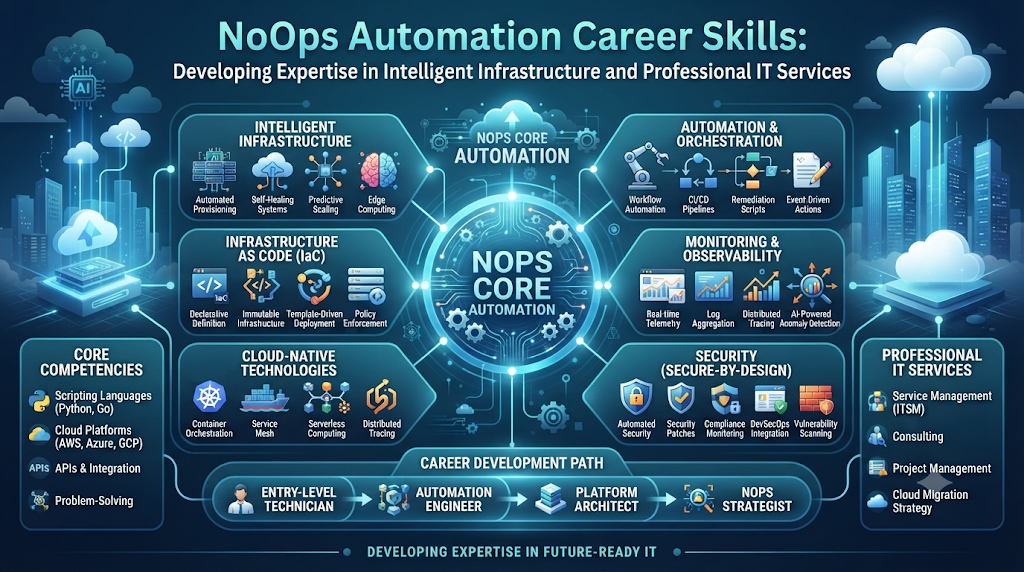
A professional learning about NoOps should understand:
- Cloud infrastructure and service management.
- Infrastructure as code and configuration management.
- Containers and orchestration platforms.
- Continuous integration and continuous delivery.
- Monitoring, logging, and observability.
- Access control and security automation.
- Incident response and recovery planning.
NoOpsSchool.com highlights learning tracks for NoOps Engineers, NoOps Architects, NoOps Managers, and NoOps Professionals. These tracks provide different learning directions based on technical responsibilities and career interests.
Why This Matters for IT Teams and Careers
Automation can help teams reduce repeated tasks and make technical processes more consistent. For example, a deployment workflow can check code, run tests, and release an approved update without requiring an engineer to perform every step manually.
This can improve productivity, but only when the automation is designed and tested carefully. Poorly written scripts can spread errors quickly. Teams therefore need professionals who understand both the technology and the risks.
For IT professionals, NoOps knowledge can support growth in several areas:
- Infrastructure engineering: Learn how to create and manage cloud resources through code.
- Platform engineering: Understand how to provide reusable tools and environments for development teams.
- Cloud operations: Build skills in monitoring, scaling, access management, and recovery.
- Automation engineering: Create workflows that reduce repeated manual activities.
- Technical leadership: Learn how to assess automation needs and guide implementation.
A useful learning plan connects technical knowledge with practical work. Instead of collecting tool names, learners should understand why a tool is used, what problem it solves, and how its output can be checked.
NoOps vs DevOps: What Is the Difference?
The discussion of NoOps vs DevOps compares two related approaches to delivering and managing technology services.
DevOps encourages collaboration between development and operations teams. It promotes shared responsibility, continuous delivery, feedback, and automation throughout the software lifecycle.
NoOps places greater emphasis on automating routine operational activities. It aims to reduce manual intervention through managed cloud services, automated infrastructure, monitoring, and standard workflows.
The difference is mainly about emphasis, not a complete separation.
Comparing the approaches
- DevOps: Builds cooperation between development and operations teams.
- NoOps: Focuses on reducing repetitive operations through automation.
- DevOps responsibilities: Teams share work across development, testing, release, and operations.
- NoOps responsibilities: Automation handles suitable routine activities, while people supervise systems and manage exceptions.
- Common ground: Both approaches can use cloud platforms, CI/CD, infrastructure as code, monitoring, and containers.
The NoOps vs DevOps discussion should not be treated as a choice where one approach must replace the other. Many organisations use DevOps practices while automating more operational tasks. The right model depends on system complexity, team skills, security requirements, and business needs.
Professionals should understand NoOps vs DevOps before selecting a learning path. This knowledge helps them explain how automation fits into an existing engineering process.
NoOps Automation Tools
NoOps automation tools are technologies that help manage infrastructure, application delivery, monitoring, and recovery with fewer manual steps. They support repeatable processes and help teams manage complex environments.
Different tools serve different purposes. A professional should learn how they work together rather than assuming that one platform can manage every part of an IT environment.
Common tool categories
Infrastructure as code tools
These tools define infrastructure through configuration files. Teams can review, reuse, and update infrastructure definitions instead of creating every resource manually. Terraform is a common example.
Container technologies
Docker packages applications and their dependencies into containers. Kubernetes helps deploy, scale, and manage container-based workloads across clusters.
CI/CD platforms
Continuous integration and continuous delivery tools automate activities such as building, testing, and releasing software. They help teams follow a consistent delivery process.
GitOps tools and practices
GitOps uses version-controlled files as a source of truth for system configuration. Changes can be reviewed and applied through automated workflows.
Observability platforms
Monitoring, logging, and tracing help teams understand application and infrastructure behaviour. These capabilities make it easier to identify unusual activity and investigate failures.
Serverless services
Serverless computing allows teams to run code without managing every part of the underlying server infrastructure. Cloud providers manage much of the platform layer, although configuration, cost, and security remain important.
How to learn these tools effectively
Start with one area, such as infrastructure provisioning. Create a small environment, document its configuration, and test how changes are applied. Then move to deployment automation, monitoring, and recovery exercises.
NoOpsSchool.com advertises learning topics that include infrastructure as code, cloud-native computing, Kubernetes, Docker, Terraform, GitOps, CI/CD, serverless, observability, and AI-powered operations. These topics can help learners build a broader understanding of NoOps automation tools and their practical uses.
NoOps Certification: What to Look For
A NoOps certification is a learning credential intended to demonstrate knowledge of automation-focused IT operations. Since NoOps is an evolving approach rather than one universal certification standard, learners should check exactly what a particular certificate covers.
A useful NoOps certification should connect its learning outcomes with practical skills. The certificate name alone is not enough to judge its value.
Points to review before choosing
- Learning coverage: Check whether the course includes cloud infrastructure, automation, monitoring, and security.
- Practical exercises: Look for labs that allow learners to create and test workflows.
- Assessment method: Understand how knowledge and practical ability are evaluated.
- Skill relevance: Compare the syllabus with the tasks you want to perform.
- Course clarity: Review the learning objectives and expected knowledge level.
A NoOps certification can help organise learning and provide evidence of completed study. However, it does not automatically prove advanced experience or guarantee a job, promotion, salary increase, or recognition by an employer.
NoOpsSchool.com focuses on NoOps education and certification learning. Before selecting any NoOps certification path, learners should review the available syllabus, practical activities, and certificate details.
NoOps Engineer Certification
NoOps engineer certification is a learning path for people interested in building, maintaining, and improving automated infrastructure. It can help learners organise their knowledge of cloud platforms, deployment workflows, infrastructure as code, and system monitoring.
A NoOps engineer certification path should give attention to practical engineering responsibilities, not only definitions and theory.
Core skills for an engineer
Infrastructure provisioning: Learn how to create cloud resources through reusable configuration files.
Deployment automation: Understand how applications move from code changes to tested releases.
Container management: Learn how Docker and Kubernetes support application packaging and orchestration.
System monitoring: Use metrics, logs, and alerts to understand service health.
Security practices: Apply access controls, secret management, and safe configuration methods.
Incident handling: Learn how to review alerts, investigate failures, and improve recovery procedures.
A learner exploring NoOps engineer certification should complete practical exercises. For example, they can create a test environment, deploy a small application, configure monitoring, and document how the system responds to a known failure.
A certificate can demonstrate structured learning, but hands-on experience remains important. Employers may assess practical ability, communication, troubleshooting, and project experience separately from certification.
NoOps Architect Training
NoOps architect training focuses on planning automated infrastructure and deciding how different technical services should work together. It is suitable for professionals who want to understand system design, cloud architecture, security, reliability, and automation strategy.
Unlike an entry-level tool course, NoOps architect training should help learners evaluate design choices and their long-term effects.
Important areas of study
- Cloud architecture: Understand how applications and infrastructure components are arranged.
- Scalability: Plan how systems can handle changes in workload.
- Reliability: Design monitoring, backups, recovery processes, and failure handling.
- Security architecture: Apply identity management, network controls, and secure configuration.
- Automation standards: Create reusable patterns that teams can follow.
- Cost awareness: Understand how resource choices affect ongoing cloud spending.
A strong NoOps architect training plan should include design exercises. Learners might compare two infrastructure designs, identify possible failure points, and explain how automated provisioning could support consistent environments.
People interested in architecture should also understand the limits of automation. Some failures require human decisions, and critical changes should include suitable approval and review steps.
NoOps Manager Certification
NoOps manager certification is a learning option for professionals who guide automation projects, coordinate technical teams, or oversee operational improvement. It focuses on planning and management rather than only hands-on configuration.
A NoOps manager certification path should explain how to assess business needs, set priorities, manage risks, and review automation outcomes.
Knowledge areas for managers
Automation planning: Identify repetitive activities that may be suitable for automation.
Team coordination: Help engineering, security, and development teams agree on responsibilities.
Risk management: Consider what could happen if an automated process fails or applies an incorrect change.
Performance measurement: Review service reliability, deployment quality, incident patterns, and process efficiency.
Governance: Establish rules for access, approvals, documentation, and change reviews.
Continuous improvement: Use feedback and operational data to improve workflows.
Professionals considering NoOps manager certification should look for learning that connects technical concepts with practical leadership decisions. They do not need to become experts in every tool, but they should understand the purpose and limitations of the systems their teams use.
A NoOps manager certification can support professional development, but its value depends on the syllabus, assessment, and relevance to the learner’s responsibilities. It should not be treated as a guarantee of management employment or career advancement.
NoOps Training Course
A NoOps training course helps learners develop knowledge through a planned sequence of lessons and practical activities. It can be useful for beginners who need a clear starting point and experienced IT workers who want to strengthen their automation skills.
A suitable NoOps training course should combine concepts, demonstrations, exercises, and review.
What a course should cover
- Foundations: Understand automation, cloud infrastructure, and the meaning of NoOps.
- Infrastructure as code: Learn how configuration files define and manage resources.
- Cloud-native systems: Explore containers, orchestration, and managed services.
- Delivery pipelines: Understand automated testing and software release processes.
- Monitoring: Learn how to use logs, metrics, and alerts.
- Security: Study identity controls, secrets, and safe deployment practices.
- Practical projects: Apply the concepts to a working test environment.
Before joining a NoOps training course, review the expected skill level and required technical knowledge. Beginners may need basic Linux, networking, and cloud concepts first.
An effective NoOps training course should also explain how to test automation safely. Learners need to understand how to detect errors, roll back changes, and document what a workflow does.
NoOpsSchool.com advertises learning tracks for engineers, architects, managers, and other NoOps professionals. Learners can review its course information to see whether the topics match their goals.
NoOps Consulting Services
NoOps consulting services help organisations review their current IT processes and identify areas where automation may be useful. These services can support teams that want to improve infrastructure provisioning, software delivery, monitoring, or cloud operations.
The purpose of NoOps consulting services should be to solve real operational problems rather than introduce automation without a clear reason.
Common consulting areas
- Operational assessments: Review existing processes and identify repeated manual work.
- Automation strategy: Decide which activities should be automated and how progress will be measured.
- Cloud-native modernisation: Review whether applications and infrastructure can benefit from cloud-native methods.
- Infrastructure provisioning: Improve the way environments are created and maintained.
- CI/CD implementation: Establish automated build, test, and delivery workflows.
- AIOps integration: Explore how AI-supported capabilities may help analyse operational information.
- Security automation: Automate suitable security checks and configuration activities.
NoOpsSchool.com advertises NoOps consulting services across areas such as operational assessments, automation strategy, cloud-native modernisation, infrastructure provisioning, CI/CD implementation, AIOps integration, and security automation.
Before choosing NoOps consulting services, organisations should define their goals, current technical limits, security requirements, and expected outcomes. They should also agree on documentation, ownership, and support responsibilities.
Automation should be introduced in stages. A small, measurable improvement is often easier to test and manage than a large change across every system.
How to Hire NoOps Freelancers
Organisations may need specialist support for a limited project, a technical assessment, or a specific automation task. In such cases, they may decide to hire NoOps freelancers rather than build every skill internally.
The decision to hire NoOps freelancers should begin with a clear description of the work. A broad request such as “automate our cloud” is difficult to estimate and evaluate.
Steps for selecting a freelancer
1. Define the task
Describe the infrastructure, current problem, expected result, and project boundaries.
2. Identify the required skills
Decide whether the work needs Terraform, Kubernetes, cloud platforms, automated monitoring, or self-healing systems.
3. Review relevant experience
Ask candidates to explain similar technical work and their role in completing it. Look for clear examples rather than unsupported claims.
4. Discuss security
Check how access, credentials, confidential information, and production changes will be handled.
5. Agree on deliverables
Set expectations for code, documentation, testing, handover, and maintenance responsibilities.
6. Start with a limited task
A small assessment or test project can help both sides understand the working process.
When businesses hire NoOps freelancers, they should also confirm who will review and maintain the delivered automation. A freelancer may complete a project, but the organisation still needs internal ownership.
NoOpsSchool.com advertises access to freelancers with skills in Terraform, Kubernetes, cloud platforms, automated monitoring, and self-healing systems. Organisations considering this route should review individual experience and project suitability before making a decision.
Table: NoOps Learning and Service Options at a Glance
| Option | What It Covers | Who It Helps |
|---|---|---|
| NoOps certification | Structured learning about automation and operations | Learners seeking a defined study path |
| NoOps engineer certification | Infrastructure, deployment, and monitoring skills | Technical engineers |
| NoOps architect training | System design, reliability, and automation planning | Architects and senior technical professionals |
| NoOps manager certification | Team coordination, governance, and project planning | IT managers and team leads |
| NoOps training course | Guided lessons and practical exercises | Beginners and working professionals |
| NoOps consulting services | Operational assessment and automation planning | Organisations improving IT processes |
| Hire NoOps freelancers | Specialist support for defined technical tasks | Teams needing project-based expertise |
Common Mistakes Learners and Teams Make
Learning NoOps or introducing automation can become difficult when people focus only on tools. The following mistakes can slow progress and create avoidable risks.
- Thinking NoOps removes all operations: Automation reduces routine work, but skilled people remain responsible for system health and decisions.
- Learning tools without understanding their purpose: A list of technologies is less useful than knowing which problem each tool solves.
- Ignoring security: Automated systems still need secure access, secret handling, and regular reviews.
- Skipping practical exercises: Reading about infrastructure as code does not replace creating and testing an environment.
- Automating an unclear process: A confusing manual process can become a confusing automated workflow.
- Ignoring failure scenarios: Teams should test what happens when deployments, services, or monitoring systems fail.
- Choosing a certificate by its name alone: Learners should examine the actual syllabus, assessments, and practical work.
- Expecting instant career results: Training can develop knowledge, but experience and communication skills also matter.
- Failing to document automation: Other team members need to understand how workflows operate and how to respond when they fail.
- Removing human review too early: Important changes may still require approval, testing, and oversight.
A Simple Example
Consider a fictional company called SignalCraft Analytics, which provides data reports to small manufacturing businesses. Its technical team regularly creates test environments, deploys application updates, and checks system performance.
The team notices that engineers spend too much time setting up similar environments and repeating basic deployment steps. It decides to improve these activities through automation.
First, the engineers define infrastructure configurations using code. They then create a deployment workflow that runs tests before releasing approved changes. Monitoring tools collect system information and send alerts when performance moves outside expected limits.
The team also prepares automated responses for a few known problems, such as restarting a service after a confirmed failure. Unusual incidents still go to engineers for investigation.
The manager reviews the process, checks whether the new workflow meets security requirements, and makes sure the team understands its responsibilities.
This fictional example shows how NoOps principles can reduce repeated work without removing human oversight. A learning path covering infrastructure as code, CI/CD, monitoring, and security can help professionals understand each part. NoOpsSchool.com advertises related learning topics for people developing these skills.
How NoOpsSchool Can Help
NoOpsSchool focuses on NoOps education, certification learning, and related professional services. Its advertised learning tracks include NoOps Engineers, NoOps Architects, NoOps Managers, and NoOps Professionals.
The site lists topics such as Terraform, Kubernetes, Docker, GitOps, CI/CD, serverless computing, observability, and AI-powered operations. It also describes hands-on labs and real-world automation scenarios involving self-healing infrastructure and automated incident response.
For organisations, the site advertises support areas that include operational assessments, automation strategy, cloud-native modernisation, and security automation. It also offers access to freelancers with selected infrastructure and automation skills.
Learners and organisations should review the available details and confirm that a particular learning or service option matches their requirements.
Frequently Asked Questions About NoOps Automation Careers
1. How can someone explain what is NoOps to a beginner?
What is NoOps can be explained as an approach that uses automation to reduce repeated IT operations work. It relies on cloud services, infrastructure automation, monitoring, and standard workflows. People still manage security, review changes, and handle problems that automated systems cannot resolve.
2. What should learners check before choosing NoOps certification?
Before choosing NoOps certification, review the syllabus, practical exercises, assessment method, and learning outcomes. Check whether the topics match your current skills and career goals. A certificate can show completed learning, but it does not guarantee employer recognition or a particular job.
3. Does NoOps engineer certification require programming knowledge?
NoOps engineer certification may involve scripting, configuration files, and automation workflows. Basic programming knowledge is useful, but the required level depends on the learning path. Beginners can start with simple scripts and gradually practise infrastructure provisioning, deployment, and monitoring.
4. How does NoOps architect training help with system design?
NoOps architect training helps learners consider how infrastructure, cloud services, security, monitoring, and automation fit together. It develops design thinking around reliability and scalability. Practical architecture exercises can help learners compare solutions and identify possible risks before implementation.
5. Who may benefit from NoOps manager certification?
NoOps manager certification may suit IT managers, team leads, and professionals responsible for automation projects. It can help them understand planning, governance, team coordination, and performance measurement. Its usefulness depends on the syllabus and how closely it matches their management responsibilities.
6. What makes a NoOps training course useful for working professionals?
A NoOps training course is useful when it combines clear lessons with practical activities. Learners should have opportunities to work with infrastructure as code, deployment pipelines, monitoring, and security controls. Exercises should also explain how to test changes and handle failures safely.
7. When should a company consider NoOps consulting services?
A company may consider NoOps consulting services when manual processes create delays, repeated errors, or difficulties managing infrastructure. An assessment can help identify suitable automation opportunities. The organisation should define its goals, security needs, technical limits, and ownership responsibilities before starting.
8. What should a business consider before it decides to hire NoOps freelancers?
Before deciding to hire NoOps freelancers, a business should define the project scope, required tools, security rules, and expected deliverables. It should review relevant experience and agree on documentation and handover. Internal staff should remain responsible for ongoing system ownership.
9. How should teams evaluate NoOps vs DevOps for an existing environment?
When comparing NoOps vs DevOps, teams should review their current workflows, responsibilities, and automation needs. DevOps supports shared development and operations practices, while NoOps emphasises reducing manual operational tasks. Many teams can combine both approaches instead of replacing one with the other.
10. What learning options does NoOpsSchool advertise?
NoOpsSchool.com advertises learning tracks for engineers, architects, managers, and NoOps professionals. Its listed topics include cloud-native computing, Terraform, Kubernetes, CI/CD, GitOps, serverless, and observability. Learners should review the current course information to confirm the content and suitability of each option.
Final Thoughts
NoOps automation is about improving how IT systems are built, managed, and monitored. It can reduce repeated manual work, but reliable technology still depends on skilled people, clear processes, and proper security. Professionals can develop useful knowledge by studying cloud infrastructure, automation tools, deployment workflows, and system observability. Organisations can apply the same ideas through careful planning, consulting support, or specialist project work. NoOpsSchool.com provides advertised learning tracks and related professional services for people exploring this area. The best next step is to choose a practical skill, build a small project, and learn how to maintain it safely.