Introduction
Patients researching cardiac hospitals may see ratings, accreditation badges, certifications, patient-safety information, and quality scores. These terms can look similar, but they do not all measure the same thing. A rating may summarize selected quality or patient-experience information, while accreditation involves an external review against defined standards. Certification may focus on a particular service or clinical program. Understanding these differences can help patients and families read hospital information more carefully instead of relying on one number or badge. BestCardiacHospitals provides general information for people researching cardiac care. The goal is to look at several useful quality signals and consider them alongside the hospital’s services and the patient’s specific medical needs.
What Does Cardiac Hospital Accreditation Mean?
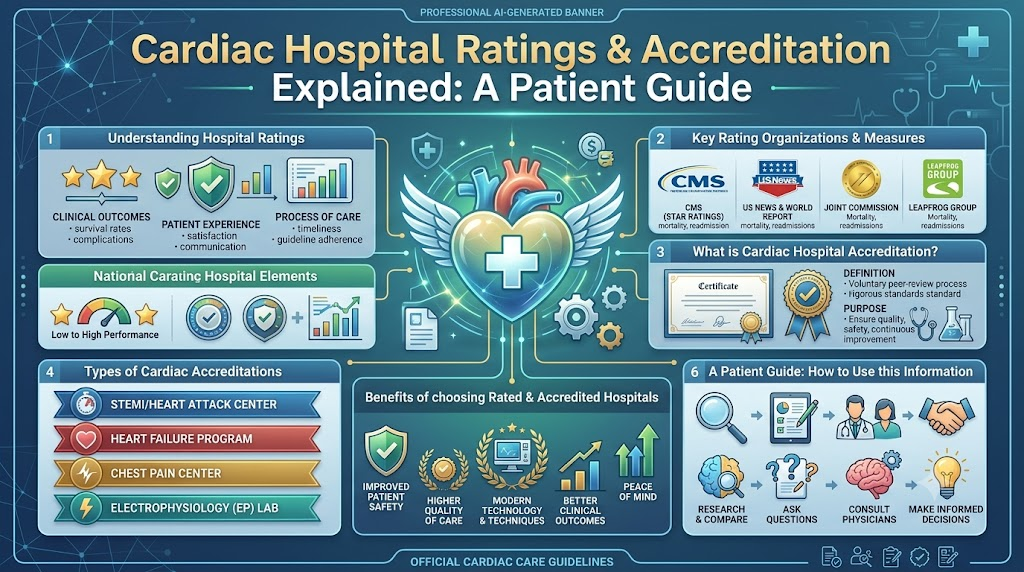
Healthcare accreditation is a formal evaluation in which an independent organization assesses whether a healthcare organization meets defined quality and safety standards.
Accreditation standards may cover areas such as patient safety, infection prevention, medication management, patient rights, care processes, staff practices, and systems for improving quality. For example, the Joint Commission describes accreditation as an objective evaluation process designed to help healthcare organizations measure and improve quality and patient safety.
The exact requirements depend on the accrediting organization, country, healthcare system, and accreditation program. Some accreditation processes include onsite surveys, record reviews, observations, and interviews with staff or patients.
Accreditation should therefore be viewed as information about an organization’s quality and safety systems, not as a guarantee of a particular patient’s outcome.
What Do Cardiac Hospital Ratings Mean?
A cardiac hospital rating may be based on different types of information. Depending on the organization providing the rating, it might use clinical quality measures, patient experience information, safety data, reported outcomes, surveys, reputation information, or a combination of these.
The methodology matters. Different organizations may use different data sources, time periods, patient groups, and scoring methods. As a result, two ratings for the same hospital may measure different aspects of care.
Instead of focusing only on an overall number or star rating, look at what the rating actually measures and whether the information relates to the cardiac service you need.
Accreditation, Certification, and Ratings: What Is the Difference?
These terms are related but not interchangeable.
Accreditation generally evaluates an organization against broader standards. Depending on the program, it may examine many parts of a hospital’s quality and safety systems.
Certification usually focuses on a particular service, program, or area of care. The Joint Commission, for example, describes certification as an evaluation of specialized programs or services, including certain cardiac services.
Ratings are summaries or assessments produced using selected measures and a defined methodology. A rating does not necessarily involve the same type of formal external survey used for accreditation.
Understanding exactly what each recognition covers can prevent confusion.
Why Does Accreditation Matter for Cardiac Care?
Cardiac care often involves several teams, tests, procedures, medicines, and stages of care. Quality standards can encourage hospitals to maintain consistent processes, identify risks, monitor performance, and work on improvements.
Accreditation surveys may examine how an organization follows standards in real-world care. The Joint Commission’s current process includes onsite evaluation and methods for following patients’ care experiences through different parts of an organization.
Accreditation approaches can also change over time. In 2026, the Joint Commission’s Accreditation 360 framework emphasizes continuous engagement, improvement, accountability, and patient safety rather than treating accreditation as a static checklist.
What Can Cardiac-Specific Certification Cover?
A cardiac-specific certification may focus on a particular cardiac service rather than the entire hospital.
Depending on the program, specialized quality evaluation may relate to areas such as heart attack care, heart failure services, chest pain care, cardiac procedures, cardiac surgery, emergency cardiac treatment, quality measurement, patient safety, or coordination of care.
A certification for one program should not automatically be assumed to cover every cardiac procedure or every department in the hospital. Always check exactly which service or program received the certification.
How to Read a Cardiac Hospital Rating
Start by asking what the rating measures.
Check the date of the information, because quality measures can change. Look at the patient population included and, when available, how many patients or cases were represented.
Then consider whether the rating relates to:
- Clinical outcomes
- Patient safety
- Patient experience
- Cardiac-specific services
- Emergency care
- A particular procedure or condition
A patient-experience rating can provide useful information about communication or hospital experience, while a clinical outcome measure may provide different information. Neither automatically describes every part of cardiac care.
Important Quality Indicators for Cardiac Hospitals
Patients may want to investigate several areas rather than relying on a single quality signal.
Depending on the condition, useful information may include cardiac surgery experience, emergency cardiac services, cardiac intensive care, diagnostic capabilities, infection-prevention practices, specialist availability, care coordination, rehabilitation, follow-up services, and reliable clinical quality measures.
The importance of each factor depends on the treatment required. Someone being evaluated for a heart rhythm problem may need different services from someone preparing for complex cardiac surgery.
How Can Patients Verify Hospital Accreditation?
First, identify who granted the accreditation. Then check whether it is current and determine exactly what facility, location, program, or service it applies to.
Accreditation may cover an entire organization or a specific healthcare program. Recognized accreditation organizations generally maintain information about organizations they evaluate, although verification methods vary by country and accreditation system.
For example, Joint Commission and Joint Commission International provide information about their accreditation processes and accredited organizations.
Do not rely only on a hospital website badge or marketing statement. Where possible, verify the recognition through the accrediting organization’s own information.
Why Accreditation Alone Should Not Determine Your Choice
Accreditation is useful, but it is only one part of the picture.
Patients may also need to consider whether the hospital regularly treats their specific heart condition, whether the required specialists and facilities are available, how emergency care is organized, whether cardiac rehabilitation and follow-up are accessible, and whether costs and insurance arrangements are suitable.
A hospital’s accreditation status cannot tell you whether it is the right facility for every medical situation.
How Patients Can Compare Cardiac Hospitals Carefully
Start by identifying the cardiac service you actually need. Then collect information from several reliable sources and compare similar measures rather than placing unrelated ratings side by side.
Check the date and methodology behind quality information. Look at accreditation or certification separately from patient reviews and marketing claims.
When appropriate, discuss hospital-specific questions with your cardiologist or cardiac surgeon. A medical professional familiar with your condition may help explain which services and facilities are relevant to your care.
Quality Information at a Glance
| Quality Information | What It Measures | What Patients Should Check |
|---|---|---|
| Accreditation | Compliance with defined organizational standards | Accrediting body, current status, and scope |
| Certification | Quality of a specific program or service | Exact cardiac service covered |
| Clinical quality measures | Selected aspects of care or outcomes | Measure definition, date, and patient population |
| Patient experience rating | Reported experiences of patients | Survey method and questions used |
| Hospital rating | Combination of selected measures | Methodology, data sources, and time period |
Limitations of Hospital Ratings and Accreditation
No single rating provides a complete picture of a hospital.
Ratings may differ because organizations use different methodologies, patient populations, data periods, and measures. Some information may also be incomplete or updated at different times.
Accreditation has limitations as well. It shows that an organization was evaluated against a particular set of standards, but it does not mean every patient will have the same experience or outcome.
Quality information is most useful when read in context.
Frequently Asked Questions
1. What does cardiac hospital accreditation mean?
It means an external organization has evaluated a healthcare organization against defined standards. The standards may cover quality, patient safety, care processes, and other healthcare systems.
2. How do cardiac hospital ratings work?
Ratings use selected information to summarize aspects of hospital quality, safety, outcomes, patient experience, or other measures. The exact method varies between rating organizations.
3. What is the difference between accreditation and certification?
Accreditation generally evaluates broader organizational standards, while certification often focuses on a specific clinical program or service. They should not be treated as identical forms of recognition.
4. Does accreditation guarantee good treatment outcomes?
No. Accreditation indicates that an organization was evaluated against particular standards. It does not guarantee a specific outcome for an individual patient.
5. How can patients verify accreditation?
Identify the accrediting organization and check its current information about accredited organizations. Also confirm whether the recognition applies to the entire hospital, a particular location, or a specific service.
6. What does cardiac-specific certification mean?
It generally means a particular cardiac program or service has been evaluated against specialized standards. Patients should check exactly what service the certification covers.
7. What quality indicators should patients review?
Depending on their needs, patients may review cardiac services, safety measures, clinical quality information, specialist availability, intensive care, rehabilitation, and follow-up services.
8. Are online hospital ratings reliable?
They can provide useful information, but their value depends on the data, methodology, date, and patient population used. A rating should be interpreted alongside other reliable information.
9. Why might two hospitals have different ratings?
Different organizations may measure different things or use different scoring systems, data periods, and patient populations. Two ratings may therefore not be directly comparable.
10. What should patients consider besides ratings and accreditation?
Consider the hospital’s experience with your specific cardiac condition, available specialists and facilities, emergency services, follow-up care, rehabilitation, costs, insurance arrangements, and information from your healthcare team.
Conclusion
Cardiac hospital ratings and accreditation can provide useful information about quality systems, patient-safety processes, specialized services, and selected aspects of hospital performance. However, they should not be treated as guarantees or as a complete picture of care. Patients should look at what each rating or accreditation actually measures, verify that the information is current, and consider the hospital’s experience, facilities, specialists, follow-up services, and their own cardiac needs. Taking a broader view can help patients and families make informed healthcare decisions based on relevant information rather than a single badge, score, or rating.