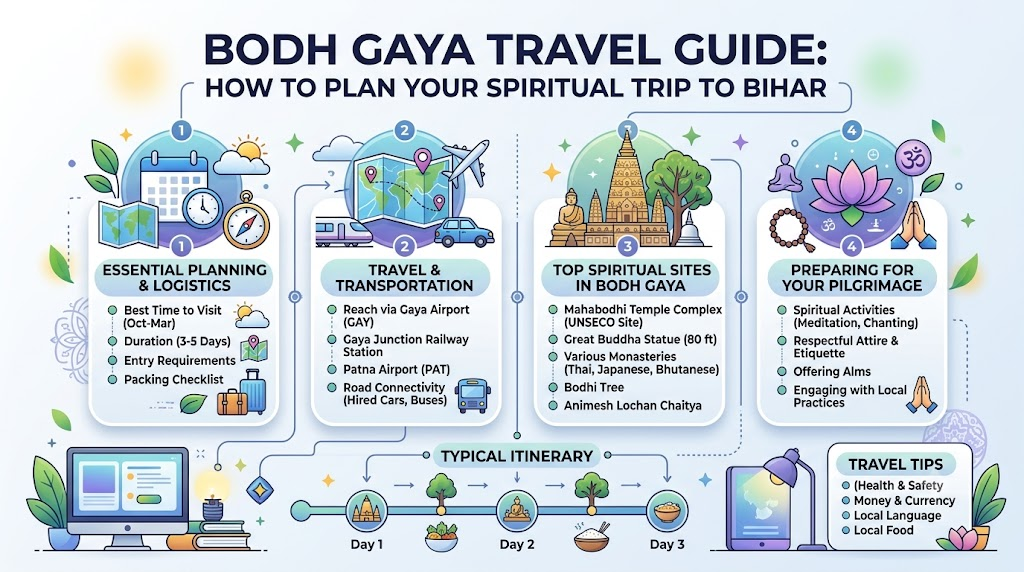
Introduction
Bodh Gaya holds a unique place in world history as the sacred ground where Prince Siddhartha attained enlightenment under the Bodhi Tree and became the Buddha over 2,500 years ago. Situated in the Gaya district of Bihar along the banks of the Phalgu River, this UNESCO World Heritage site draws spiritual seekers, historians, and curious travelers from across the globe. Beyond its deep religious roots, the town offers a quiet blend of ancient heritage, international Buddhist architecture, and regional Bihari culture.Whether you are planning a quiet weekend retreat, a heritage tour, or a multi-stop circuit across the state, this comprehensive Bodh Gaya travel guide offers the practical details you need. Readers exploring local heritage through platforms like Mera Apna Bihar will find this guide useful for mapping out transportation options, historical contexts, cultural nuances, and real-world travel itineraries to make the most of their visit.
Overview of Bodh Gaya
Bodh Gaya is a compact town located approximately 16 kilometers south of Gaya city in central Bihar. While it remains one of the world’s most significant pilgrimage sites for Buddhists, its historical and architectural appeal attracts visitors of all cultural backgrounds. The focal point of the town is the Mahabodhi Temple Complex, surrounded by serene gardens, meditation parks, and foreign monasteries established by Buddhist nations including Thailand, Japan, Bhutan, Sri Lanka, and Myanmar.
Unlike commercial urban hubs, Bodh Gaya operates at a measured pace. The town center is walkable, centered primarily around the temple grounds and Main Road markets. Nearby village settlements offer glimpses into rural Bihari life, traditional crafts, and agriculture, providing a well-rounded destination for those interested in heritage tourism.
Why Is Bodh Gaya Important?
The historical and cultural value of Bodh Gaya rests on several distinct pillars:
- Spiritual Significance: It is the primary location among the four sacred Buddhist pilgrimage sites (alongside Lumbini, Sarnath, and Kushinagar).
- Architectural Value: The Mahabodhi Temple represents one of the earliest brick structures surviving in eastern India, showcasing classical Gupta-era structural transitions.
- Global Cultural Footprint: National monasteries built by various governments reflect diverse international architectural traditions within a single township.
- UNESCO World Heritage Status: In 2002, the Mahabodhi Temple Complex was designated a UNESCO World Heritage site for its archaeological and cultural importance.
History and Heritage of Bodh Gaya
Ancient Origins and the Mauryan Era
In the 6th century BCE, Siddhartha Gautama wandered across the Magadha region before settling beneath a pipal tree in the village then known as Uruvela. After 49 days of continuous meditation, he attained supreme enlightenment (Nirvana).
In the 3rd century BCE, the Mauryan Emperor Ashoka visited Uruvela to pay homage. He established a shrine and a direct pillar marking the site, effectively laying the foundation for Bodh Gaya as a central hub of learning and devotion. Ashoka’s visits are documented in rock edicts, making Bodh Gaya an essential site for understanding early Magadhan history.
+-------------------------------------------------------------------+
|                  CHRONOLOGY OF BODH GAYA HISTORY                   |
+-------------------------------------------------------------------+
| 6th Century BCE : Siddhartha Gautama attains Enlightenment        |
| 3rd Century BCE : Emperor Ashoka visits and constructs first shrine |
| 5th-6th Cent. CE: Construction of current Mahabodhi brick temple   |
| 19th Century CE : Major archaeological restorations begin          |
| 2002 CE         : UNESCO designates Complex World Heritage Site   |
+-------------------------------------------------------------------+
The Evolution of the Mahabodhi Temple Complex
The structural temple seen today dates back primarily to the 5th and 6th centuries CE during the Gupta period, with subsequent repairs made during the Pala Dynasty (8th–12th centuries). Following period declines, major restoration works were undertaken in the late 19th century under Alexander Cunningham and Sir Edwin Arnold, restoring the soaring 55-meter central spire (shikhara) and surrounding stone railings.
Major Attractions and Tourist Places in Bodh Gaya
1. Mahabodhi Temple Complex
The heart of Bodh Gaya is dominated by the grand 180-foot pyramidal temple spire. Inside the main sanctuary sits a gilded statue of Buddha in the famous Bhumisparsha Mudra (earth-touching posture). Surrounding the main structure are ancient stone railings (vedika) dating back to the Sunga and Gupta periods, carved with scenes depicting flora, fauna, and mythology.
2. The Sacred Bodhi Tree
Located directly behind the main temple structure, this ancient pipal tree (Ficus religiosa) is believed to be a direct descendant of the original tree under which Buddha sat. Pilgrims gather beneath its canopy to meditate, pray, and chant quiet verses throughout the day.
3. The Great Buddha Statue (80-Foot Buddha)
Unveiled in 1989 by the 14th Dalai Lama, this massive stone statue depicts Lord Buddha seated in a meditating pose atop a lotus blossom. Constructed from carved sandstone blocks by Japanese sculptors, it stands as one of the tallest outdoor Buddha statues in India.
4. International Monasteries
Bodh Gaya’s international quarter features distinctive monastic architecture built by foreign nations:
- Thai Monastery: Features a classic sloping roof structure with gold leaf detailing and traditional Thai ornamental gables.
- Royal Bhutan Monastery: Showcases intricate wood carvings, vivid frescoes, and traditional Himalayan art styles.
- Japanese Temple (Indosan Nipponji): Built in a minimalist traditional wooden aesthetic, hosting serene zen-style interior halls.
- Burmese Vihara: Exhibits classic Pagoda-style architecture, hosting quiet spaces suited for long reflection.
5. Muchalinda Lake
Situated south of the main temple complex, this quiet lake features a central sculpture showing the Buddha sheltered beneath the multi-headed hood of the Serpent King Muchalinda during a severe storm.
6. Dungeshwari Cave Temples (Mahakala Caves)
Located about 12 kilometers northeast of Bodh Gaya, these hillside caves mark where Siddhartha practiced severe austerity for six years prior to reaching Bodh Gaya. A climb up the stone steps leads to small cave shrines surrounded by scenic views of the surrounding country landscape.
Comparison of Key Bodh Gaya Destinations
| Attraction | Key Feature | Approximate Visiting Duration | Accessibility / Location |
| Mahabodhi Temple | Sacred Bodhi Tree, Ancient Brick Spire | 2–3 Hours | Central Bodh Gaya, Fully Walkable |
| 80-Foot Buddha Statue | Massive Sandstone Statue & Gardens | 45–60 Minutes | Main Road, 1 km from Mahabodhi |
| Thai Monastery | Traditional Thai Architecture & Gold Roofs | 30–45 Minutes | Near Main Market |
| Dungeshwari Caves | Historic Hillside Meditation Caves | 2–3 Hours (incl. travel) | 12 km Northeast (Requires Auto/Taxi) |
| Archaeological Museum | Ancient Sculptures & Sunga-era Railings | 1 Hour | 1 km from Main Temple (Closed Fridays) |
Regional Culture, Customs, and Etiquette
Bodh Gaya represents an intersection where regional Bihari life meets global Buddhist traditions. Visitors will experience local Hindi, Magahi, and Angika dialects spoken alongside international languages like Thai, Tibetan, and Japanese.
+-------------------------------------------------------------------+
|                    VISITOR ETIQUETTE & CUSTOMS                    |
+-------------------------------------------------------------------+
|  [DO]                                [DON'T]                      |
|  • Remove shoes at temple gates.      • Wear revealing clothing.   |
|  • Deposit mobile phones in lockers.  • Touch sacred relics/monks. |
|  • Walk clockwise around stupas.      • Make loud noise in halls.  |
|  • Dress modestly (covered knees).    • Litter on temple grounds.  |
+-------------------------------------------------------------------+
Dress Code & Behavioral Guidelines
- Attire: Modest dress covering shoulders and knees is appropriate across all temples and monasteries.
- Footwear: Shoes must be removed before entering temple compounds. Designated shoe stalls are provided near entry gates.
- Security Protocols: Mobile phones, large bags, and certain electronic devices are restricted inside the main Mahabodhi Temple inner sanctuary. Deposit counters operate near the main security checkpoint.
- Circumambulation: When walking around stupas and shrines, follow the traditional clockwise direction (pradaksina).
Local Food and Regional Cuisine
While international restaurants offering Chinese, Tibetan, and Continental meals line the tourist markets, visitors should explore Bihar’s regional culinary traditions available across local eateries in Bodh Gaya and Gaya city:
- Litti Chokha: Baked wheat balls stuffed with spiced roasted gram flour (sattu), served with roasted eggplant and tomato mash.
- Sattu Drink: A nutritious, refreshing beverage made from ground roasted chickpeas, water, lemon juice, and roasted cumin powder.
- Anarsa & Tilkut: Traditional sweets popular in the Gaya region, made using sesame seeds, rice flour, and jaggery.
- Khaja: A layered, crispy sweet pastry prepared primarily in nearby Silao and widely available across local sweet shops.
- Dal Pitha: Traditional steamed rice-flour dumplings filled with spiced lentils or sweet coconut mixtures.
Travel Itineraries for Visiting Bodh Gaya
+-------------------------------------------------------------------+
|                  SUGGESTED 2-DAY BODH GAYA ITINERARY              |
+-------------------------------------------------------------------+
| DAY 1: SACRED CORE                                                |
|   07:00 AM - Morning Visit: Mahabodhi Temple & Bodhi Tree         |
|   11:00 AM - Explore Archaeological Museum                        |
|   01:00 PM - Lunch: Local Bihari Cuisine (Litti Chokha)           |
|   03:00 PM - Great Buddha Statue & Thai/Bhutanese Monasteries      |
|   06:00 PM - Evening Prayer/Chanting at Main Temple               |
|                                                                   |
| DAY 2: EXTENDED EXPLORATION                                       |
|   07:00 AM - Excursion to Dungeshwari Cave Temples (Mahakala)     |
|   11:00 AM - Visit Sujata Stupa (Bakror Village)                  |
|   01:00 PM - Lunch & Rest                                         |
|   03:00 PM - Japanese & Burmese Monasteries                       |
|   05:00 PM - Souvenir Shopping at Local Tibetan & Handicraft Stalls|
+-------------------------------------------------------------------+
1-Day Express Itinerary
- Morning: Begin early at the Mahabodhi Temple Complex to experience quiet meditation under the Bodhi Tree. Walk around the inner grounds to view the seven sacred spots.
- Afternoon: Visit the Great Buddha Statue and walk through the nearby Thai and Royal Bhutanese Monasteries. Enjoy a local lunch in the town market.
- Evening: Cross the Falgu River bed to visit the historic Sujata Stupa in Bakror village before returning for an evening stroll around the temple zone.
2-Day Comprehensive Itinerary
- Day 1: Follow the 1-day express itinerary to cover the central heritage zone, adding a visit to the local Archaeological Museum.
- Day 2: Hire a local auto-rickshaw or taxi for a morning excursion to the Dungeshwari Cave Temples. Return by noon to explore the Japanese, Taiwanese, and Burmese monasteries. Spend the late afternoon browsing local handicraft stalls for brassware, stone carvings, and Buddhist relics.
How to Reach Bodh Gaya
Bodh Gaya is well-connected by air, rail, and road transport networks:
By Air
Gaya Airport (GAY) is located about 7 kilometers from Bodh Gaya and receives seasonal international flights from countries like Thailand, Myanmar, and Sri Lanka, along with domestic connections to key Indian cities. Alternatively, Jayprakash Narayan International Airport (PAT) in Patna is located approximately 115 kilometers away, offering frequent nationwide flight schedules.
By Train
Gaya Junction (GAYA) is the main railway hub, situated roughly 16 kilometers north of Bodh Gaya. It is connected via major rail routes to Kolkata, Delhi, Varanasi, and Patna. Auto-rickshaws, taxis, and public buses operate regularly between Gaya Junction and Bodh Gaya town center.
By Road
Bodh Gaya is accessible via National Highway 83. Direct bus services, private taxis, and tourist coaches run daily from Patna (approx. 3–4 hours travel time), Rajgir (approx. 2 hours), and Varanasi (approx. 5–6 hours).
Best Time to Visit
+-------------------------------------------------------------------+
|                      SEASONAL TRAVEL MATRIX                       |
+-------------------------------------------------------------------+
|  OCT - MAR  : [OPTIMAL] Mild weather (10°C - 25°C), major festivals.|
|  APR - JUN  : [HOT] High temperatures (35°C - 45°C), quiet travel.  |
|  JUL - SEP  : [MONSOON] Moderate rain, lush green surroundings.     |
+-------------------------------------------------------------------+
- October to March (Peak Season): Offers pleasant, cool weather suitable for walking tours and temple visits. Major global pilgrimages and international events occur during these months.
- April to June (Summer Season): Characterized by high temperatures often exceeding 40°C. While less crowded, visitors should carry hydration and plan outdoor activities during early mornings or late evenings. Buddha Jayanti usually falls in May, attracting significant gatherings despite the warmth.
- July to September (Monsoon Season): Brings moderate rainfall, turning the surrounding landscape vibrant and green. Good for visitors seeking a quieter experience with fewer tourists.
Practical Examples for Different Travelers
Example 1: History Enthusiast Visiting from Patna
- Focus: Mauryan and Gupta period architecture, stone carvings, and museum artifacts.
- Strategy: Allocate half a day specifically for the Mahabodhi Temple complex railings and the Bodh Gaya Archaeological Museum, followed by a short road trip to Sujata Stupa.
Example 2: Family Planning a Weekend Trip
- Focus: Comfortable pacing, accessible sights, and local dining.
- Strategy: Stay near the Main Temple area to minimize transit time. Use auto-rickshaws for visits to the Great Buddha Statue and nearby monasteries, ensuring relaxed breaks between outings.
Decision-Making Framework for Planning Your Visit
When planning a trip to Bodh Gaya, consider these factors:
                  [PLANNING YOUR BODH GAYA TRIP]
                                |
        +-----------------------+-----------------------+
        |                                               |
[Spiritual / Historical Focus]              [Time & Budget Constraints]
        |                                               |
  +-----+-----+                                   +-----+-----+
  |           |                                   |           |
1-2 Days   3+ Days                             1 Day       2 Days
  |           |                                   |           |
(Core Site) (Circuit: Rajgir/Nalanda)         (Express)  (Detailed)
- Travel Duration: If you have 1–2 days, focus entirely on Bodh Gaya’s primary heritage circuit. If you have 3–4 days, combine your trip with nearby historical hubs like Rajgir, Nalanda, and Gaya city.
- Mobility Needs: Bodh Gaya’s core area is compact and easily walkable, but trips to Dungeshwari Caves require climbing stone stairs.
- Budget Category: The town offers a wide spectrum of stay options, ranging from simple monastic guesthouses and budget lodges to standard star hotels.
Common Travel Mistakes to Avoid
- Overpacking the Itinerary: Trying to visit all international monasteries, ancient caves, and museum sites in a single morning leads to unnecessary rush.
- Ignoring Entry Guidelines: Attempting to take non-permitted mobile devices into the main Mahabodhi Temple compound can result in long trips back to security lockers.
- Not Confirming Transport Fares: Always clarify auto-rickshaw or taxi fares before starting your trip, especially when traveling from Gaya Junction or Gaya Airport.
- Overlooking Nearby Sites: Missing out on Sujata Stupa or Dungeshwari Caves leaves out key context regarding Prince Siddhartha’s journey prior to enlightenment.
Travel Safety & Practical Tips
- Identify Verification Requirements: Keep valid photo identification (Passport, Aadhaar, Driver’s License) accessible for hotel checks and security checkpoints.
- Hydration & Comfort: Wear easy-to-remove slip-on shoes or sandals, as footwear must be removed frequently at temple entrances. Carry a pair of thick cotton socks during summer months to walk comfortably on hot stone pathways.
- Verify Information Prior to Travel: Always double-check current transit, monument timings, and festival schedules with travel portals like Mera Apna Bihar or local tourism desks prior to departure.
- Emergency Numbers: Keep local police control room numbers and nearby medical facility contacts saved on your phone.
10 Frequently Asked Questions (FAQs)
1. What are the best tourist places to visit in Bodh Gaya?
The main attractions include the UNESCO World Heritage Mahabodhi Temple Complex, the sacred Bodhi Tree, the 80-Foot Great Buddha Statue, Muchalinda Lake, Sujata Stupa, Dungeshwari Cave Temples, and international monasteries representing Thailand, Bhutan, Japan, and Myanmar.
2. What is the best time to visit Bodh Gaya?
The ideal period is between October and March when temperatures are cool and comfortable for sightseeing. Important festivals like Nyingma Monlam and various Buddhist gatherings take place during these winter months.
3. How many days are enough for a Bodh Gaya trip?
A 2-day trip is generally sufficient to explore all major attractions, international monasteries, historical shrines, and nearby sites like Sujata Stupa and Dungeshwari Caves without feeling rushed.
4. How can travelers reach Bodh Gaya from Patna?
Travelers can take a direct train from Patna Junction to Gaya Junction (approx. 2.5 to 3 hours), followed by a 30-minute auto-rickshaw ride. Alternatively, taxis and buses run directly via National Highway 83.
5. Are mobile phones allowed inside the Mahabodhi Temple?
Mobile phones and certain electronic devices are restricted inside the main inner temple complex. Visitors must deposit their phones at secure, designated lockers located near the entrance security building.
6. What local food should visitors try in Bodh Gaya?
Visitors should try classic regional Bihari dishes like litti chokha, sattu beverages, and traditional Gaya sweets like anarsa and tilkut, alongside international cuisines served at town restaurants.
7. Is Bodh Gaya safe for solo and family travelers?
Yes, Bodh Gaya is generally considered safe and welcoming for both solo travelers and families. As with any travel destination, visitors should exercise basic precautions, avoid unlit areas late at night, and use reliable transport.
8. How far is Bodh Gaya from Gaya Railway Station?
Bodh Gaya is approximately 16 kilometers south of Gaya Junction Railway Station. Auto-rickshaws, private taxis, and shared buses connect the station to Bodh Gaya throughout the day.
9. Can visitors combine a trip to Bodh Gaya with Rajgir and Nalanda?
Yes, a popular Bihar travel circuit connects Bodh Gaya with Rajgir (approx. 70 km away) and Nalanda (approx. 85 km away). This entire circuit can easily be covered across a 3- to 4-day itinerary.
10. What dress code should travelers follow when visiting temples in Bodh Gaya?
Travelers should dress modestly out of respect for local customs and monastic rules. Clothes covering shoulders and knees are recommended when entering the Mahabodhi Temple and various foreign monasteries.
Conclusion
Bodh Gaya remains one of the world’s most enduring destinations for history, reflection, and quiet travel. From the ancient brickwork of the Mahabodhi Temple to the quiet paths of surrounding villages, the town offers a distinct look into eastern India’s spiritual and cultural roots. By planning your transport, respecting local temple guidelines, and taking time to explore both major monuments and regional life, you can enjoy a smooth and memorable journey. For more practical travel guides, destination breakdowns, and cultural insights across Bihar, explore regional guides available on Mera Apna Bihar to help plan your next itinerary.